
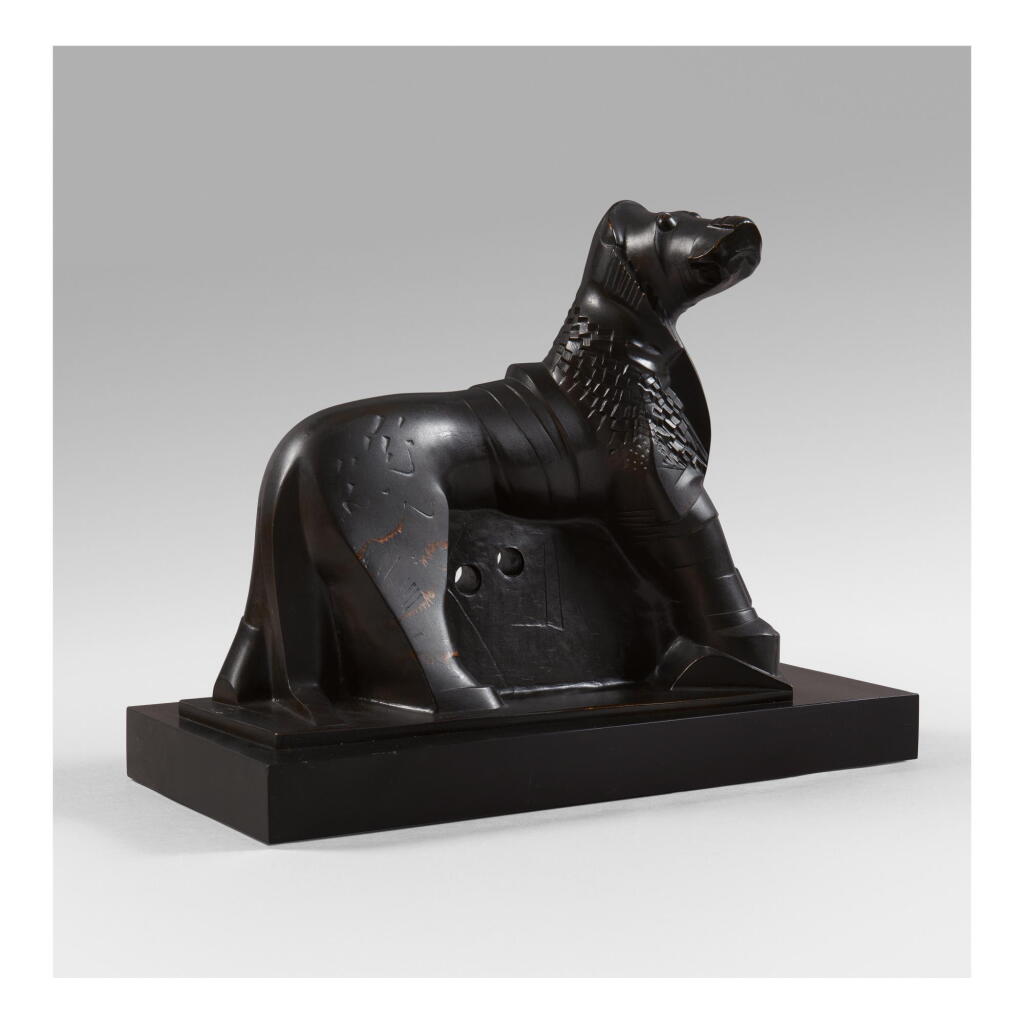
GUSTAVE MIKLOS | ANIMAL
Auction Closed
December 12, 12:31 AM GMT
Estimate
120,000 - 180,000 USD
Lot Details
Description
GUSTAVE MIKLOS
1888 - 1967
ANIMAL
1926
Executed by Fonderie Valsuani, Paris
Patinated bronze
Signed G. MIKLOS and impressed VALSUANI CIRE PERDUE
13¼ x 17¼ x 7⅞ in.; 33.6 x 43.8 x 20 cm
Collection of Félix Marcilhac, Paris
Private Collection, 1977
Christie's Paris, November 30, 2006, lot 102
Gustave Miklos, Galerie de la Renaissance, Paris, May 4-15, 1928
Gustave Miklos, Galerie l'Enseigne du Cerceau, Paris, 1972
Gustave Miklos: Exposition Rétrospective, Centre Culturel Aragon, Oyonnax, France, December 20, 1983-January 29, 1984
Gustave Miklos, exh. cat., Galerie de La Renaissance, Paris, 1928, no. 7 (for the present lot illustrated)
Jean Guiffrey, "Gustave Miklos," La Renaissance de l'Art Francais et des Industries de Luxe, January 1928, p. 200 (for the present lot illustrated)
La Sculpture Décorative Moderne, Série Nouvelle, Paris, circa 1930, pl. 29 (for the present lot illustrated)
Gustave Miklos, exh. cat., Galerie L'Enseigne du Cerceau, Paris, 1972, no. 14 (for the present lot illustrated)
Gustave Miklos: Exposition Rétrospective, exh. cat., Centre Culturel Aragon, Oyonnax, 1983, p. 3 (for the present lot illustrated)
Alastair Duncan, Art Deco Sculpture, New York, 2016, p. 106 (for a period photograph of the present lot illustrated in the artist's studio)
Gustave Miklos was one of many Paris-based artists who worked under the patronage of Jacques Doucet, the well-known fashion designer and celebrated art collector. Miklos was a Budapest-born artist who studied at the Hungarian Royal National School of Arts and Crafts and moved to Paris in 1909 to pursue an artistic career. Having shown paintings at the Salon d’Automne and frequented prominent artistic circles, Miklos eventually met Doucet in 1919, marking the beginning of a long-lasting collaboration. Doucet had a significant impact on the artist’s career, commissioning several sculptures and challenging him to explore a variety of new mediums including bronze sculpture, painting and jewelry. In 1923, Miklos started to experiment with relief sculpture and the work that ensued rapidly showed the influence of the avant-garde sculptures of Amedeo Modigliani and Jean Chauvin.
A key moment in the artist’s career was his first solo exhibition at the Galerie de la Renaissance in 1928, which included many bronze sculptures of fantastical animals, some directly commissioned by Doucet himself. This impressive presentation certainly helped Miklos solidify his reputation as an animalier sculptor and highlighted his methodological, non-figurative approach to animal forms. Of the 1928 exhibition, Jean Guiffrey enthusiastically wrote in the periodical La Renaissance de l’Art Français: “Here a dog, there a deer, all somewhat fantastical. These works display a smart use of planes, volumes and mass; the lines that decorate their surface charm by their mysterious logic and their happy development. The mind is satisfied with the result as the elegant solution to a problem, a well-balanced final form that is beautiful in its well-ordered nature.”
Animal was one of the 30 works presented in the exhibition, which also included a related piece titled Deux Bêtes Affrontées showing related unidentified animals in similar poses. The latter was recently sold at Sotheby’s Paris (Ginette et Alain Lesieutre, Collection Privée, June 29, 2017, lot 11) and achieved a new world auction record for an animalier work by the artist. This important piece was one of the many lots that were sent to Doucet’s new residence at 33 rue Saint-James in Neuilly, where he moved in August 1928. The collector had begun renovating the interior in 1926 and furnished it with works by innovative artists like Pierre Legrain, Marcel Coard, Rose Adler, Eileen Gray and Etienne Cournault. An archival photograph documents the Deux Bêtes Affrontées amidst a remarkably rich context in Doucet’s apartment. The sculptures are presented on a console by Pierre Legrain that is now part of the collection of the Musée des Arts Décoratifs in Paris, next to a curule seat now at the Musée Angladon in Avignon and a round coffee table also by Legrain. Works by Chaïm Soutine, Henri Matisse, Pablo Picasso and Alfred Sisley are pictured above the two animals, and a Miklos rug, held in the collections of the Musée des Arts Décoratifs in Paris, covers the floor. Doucet had little time to enjoy this exceptional collection and died in 1929.
The present lot, also created at the Fonderie Valsuani, displays an equally masterful treatment of the medium and represents one of Miklos’ most successful figurative sculptures of an animal in patinated bronze. The deliberately vague title emphasizes the mythological character of the sculpted creature, whose body displays abstract details and minutious incisions.
Before he moved to a small French town in the Jura region of France in 1940, Miklos continued his exploration of sculpture and consistently worked with Parisian decorators and designers throughout the 1930s, ultimately leading to his participation in the Union des Artistes Modernes’ pavilion at the Exposition Internationale de Paris in 1937. He is now best remembered for creating a distinct sculptural language combining hints of figuration with Cubist-inspired forms and compositions, of which the present Animal is a prime and well-documented example.