Robert Mnuchin: Collector at Heart
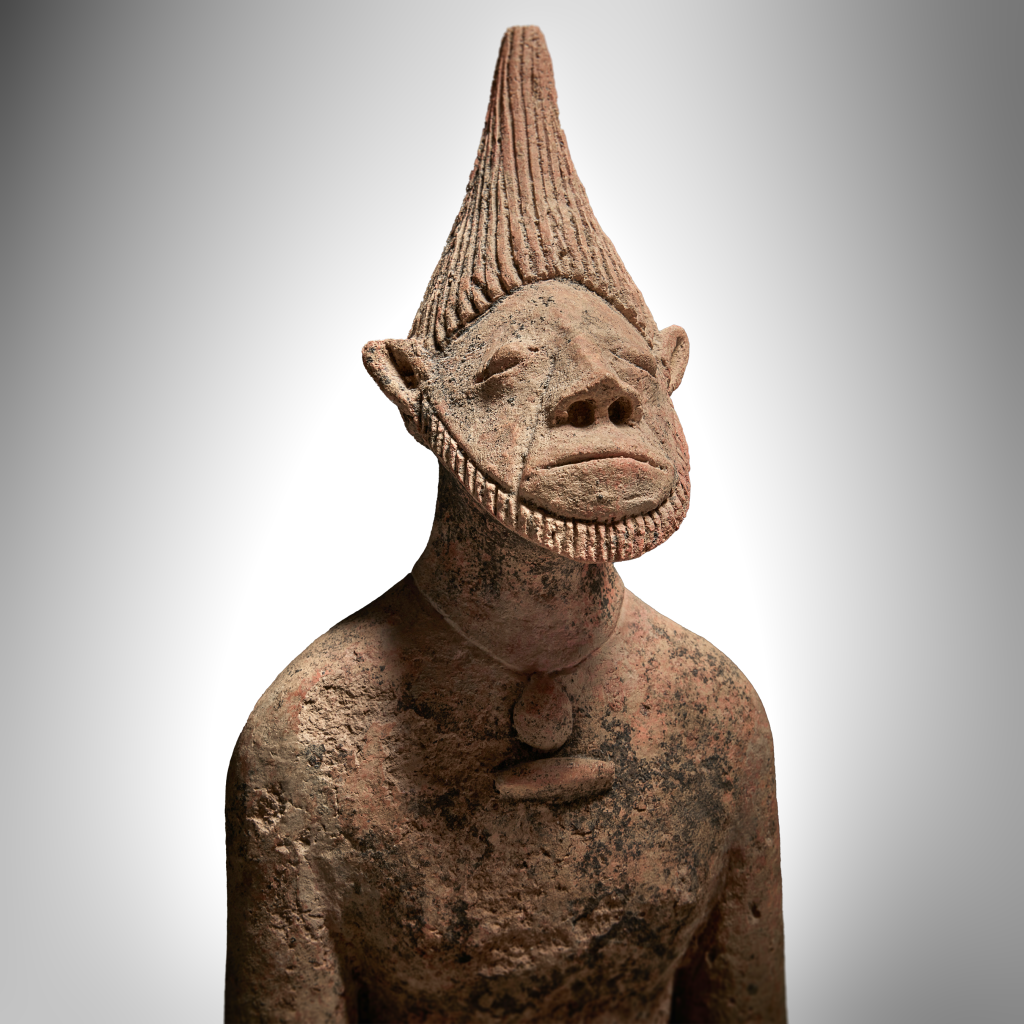
Seated Figure, Middle Niger Civilization, Mali
Circa 12th - 14th Century
Auction Closed
June 18, 05:01 PM GMT
Estimate
200,000 - 300,000 USD
Lot Details
Description
Robert Mnuchin: Collector at Heart
Seated Figure, Middle Niger Civilization, Mali
Circa 12th - 14th Century
Terracotta
Height: 20 ½ in (52.1 cm)
Alain de Monbrison, Paris
Philippe Guimiot, Brussels, acquired from the above by August 1, 1981
Sidney and Bernice Clyman, Scarsdale, New York, acquired from the above on January 26, 1982
Sotheby’s, New York, African Art from the Collection of Sidney and Bernice Clyman, June 30, 2020, lot 10
Acquired at the above auction by the present owner
The Metropolitan Museum of Art, New York, Sahel: Art and Empires on the Shores of the Sahara, January 30 – March 12, 2020 and August 29 – October 26, 2020
Bernard de Grunne, Djenné-Jeno: 1000 Years of Terracotta Statuary in Mali, Brussels, 2014, n.p., pl. 168 (illustrated), and p. 385, cat. no. 168 (listed)
Alisa LaGamma, ed., Sahel: Art and Empires on the Shores of the Sahara, New York, 2020, p. 98, cat. no. 42 (illustrated), and p. 279, cat. no. 42 (listed)
In his chronology of the tradition of the Middle Niger Civilization Bernard de Grunne assigns this magnificent sculpture to what he terms the “Pre-Classical Period”.1 Sculptures of this period are remarkable for the naturalism with which the human body is rendered, the subtle modelling of limbs and musculature, and the quiet complexity of their postures, the expressive qualities of which seem, even now, resistant to precise interpretation.
Indeed, the six centuries or so that separate us from the makers of these sculptures have done little to clarify the circumstances of their creation. They exist in a zone of uncertainty, carrying with them traces of meanings that can only be imperfectly reconstructed. Drawing upon testimony gathered from Mande informants and upon the archaeological investigations of Roderick and Susan McIntosh, de Grunne advanced the hypothesis that these terracotta figures once served as effigies of divinities venerated by the inhabitants of the now-lost urban centres of the Inland Niger Delta, each figure distinguished by physical attributes that signaled the particular rites, obligations, or forms of devotion associated with the deity it represented.2 Whether such conjectures bring us appreciably closer to the beliefs of those distant communities remains difficult to determine, yet they suggest the outlines of the religious landscape.
What emerges most clearly from the surviving works is their striking stylistic coherence, as though they had originated within a single workshop, or perhaps under the direction of a master sculptor whose manner was faithfully continued by his successors.3 One is inclined to imagine commissions undertaken for private shrines, or for a sacred precinct dedicated to an ancestral figure whose history had passed into legend by the time these sculptures were fashioned.
1 Bernard de Grunne, Djenné-Jeno: 1000 Years of Terracotta Statuary in Mali, Brussels, 2014, p. 237
2 Ibid., p. 44
3 In his discussion of the seated figure from the Malcolm collection Heinrich Schweizer suggests that its similarities to the present figure are such that “they appear to be works by the same artist.” (Heinrich Schweizer, Visions of Grace, Milan, 2014, p. 23).
You May Also Like