PROPERTY FROM A PRESTIGIOUS EUROPEAN PRIVATE COLLECTION
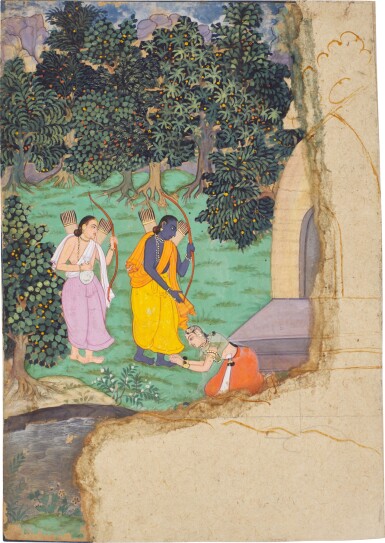
A folio from the ‘Burnt Edge’ Ramayana series: A female devotee (probably Shabari) kneeling at Rama’s feet, with Lakshmana standing behind, India, Sub-imperial Mughal, circa 1605
Auction Closed
October 23, 01:24 PM GMT
Estimate
15,000 - 20,000 GBP
Lot Details
Description
gouache heightened with gold on paper, laid down on later card, verso with 12 lines of devanagari script in black and red ink, losses to edges
26.7 by 18.7cm.
Acquired from Robert Ellsworth, New York, July 1993
The young, bejewelled woman kneeling at Rama's feet is likely to be Shabari, an ardent devotee, as referenced in the Sanskrit inscription on the reverse. However, the text of the Ramayana describes Shabari as an elderly ascetic, who waited for Rama for several years, saving berries for his arrival.
This illustration is from an important Ramayana series commissioned during the reign of Mughal Emperor Akbar. A Bureau of Records and Translation (maktab khana) had been created under Akbar’s orders at his capital city, Fatehpur Sikri. One of the aims of this bureau was to translate important Hindu epics such as the Mahabharata and the Ramayana from Sanskrit to Persian, and to subsequently have them illustrated in the imperial workshops. Four illustrated copies of the Ramayana were made, three of these were for Mughal family members, and the fourth for a Rajput ruler. The latter is now known as the ‘Burnt Edge’ series (McInerney, Kossak and Haidar 2016, p.31). As the name indicates, the edges of its folios appear to have been damaged in a fire at some stage.
It has been suggested by Terence McInerney that the ‘Burnt Edge’ Ramayana was made for Raja Bir Singh Deo Bundela (d.1627) who served under Akbar before taking the kingdom of Orchha in central India. This manuscript is the only one among the four illustrated Ramayana series commissioned in the Akbar period to have text in Sanskrit on the reverse. (ibid., p.33).
Four folios from this series are in the Metropolitan Museum of Art, New York (2002.503, 504, 506; 2022.218). One folio is in the Cleveland Museum of Art (2013.306). Another folio was in the collection of Howard Hodgkin, illus. in Topsfield 2012, no.8, pp.38-39. For folios which sold at auction, see Sotheby’s, London, 23 May 2006, lot 77; and more recently, 24 April 2024, lot 146.
You May Also Like