Property from a Private English Collection
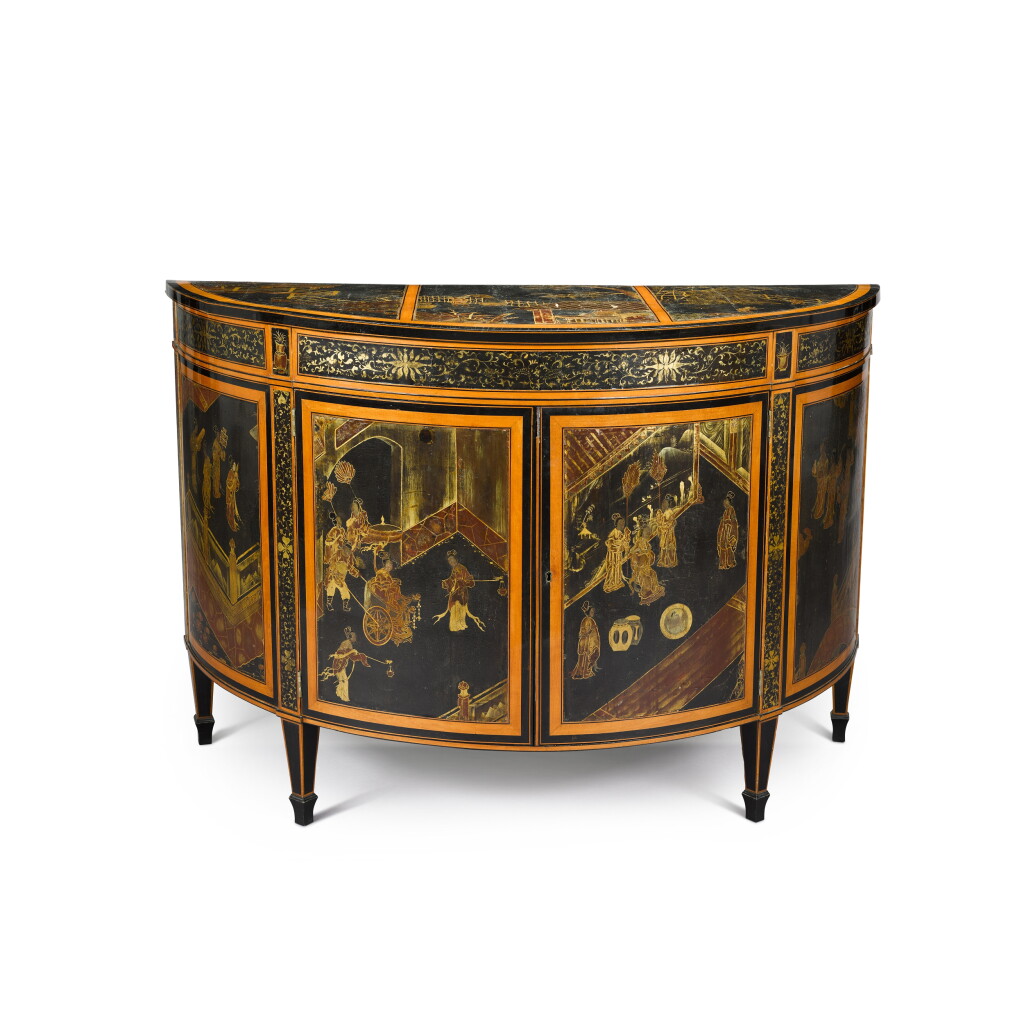
A George III lacquer and satinbirch demi-lune commode, late 18th century
Lot Closed
November 8, 01:28 PM GMT
Estimate
50,000 - 70,000 GBP
Lot Details
Description
Property from a Private English Collection
A George III lacquer and satinbirch demi-lune commode, late 18th century
with inset Chinese lacquer panels throughout depicting figures and natural scenes, with two panel doors opening onto one shelf, on square tapering feet, with three cramp cuts to the reverse
92cm. high, 137cm. wide, 61.5cm. deep;
3ft. 1/4in., 4ft. 6in., 2ft. 1/4in.
By repute, from the collection of the Dukes of Westminster;
Partridge Fine Arts, 2 October 1979;
Sotheby's London, Important English Furniture Including Magnificent Chinese Mirror Paintings and English Furniture from the Horlick Collection, 5th June 2007, lot 65.
These rare and richly-decorated commodes incorporate panels of lacquer produced in China and thus are an expression of the eighteenth-century aesthetic interest in the Far East known as chinoiserie. Access to China for travellers and for trade remained restricted, creating a cultural distance and mystique that prompted artists to draw on Chinese motifs in creating imaginative, wholly original designs. While chinoiserie often refers to pieces of European manufacture that take design influence from China, such as the inclusion of carved fretwork on mahogany furniture or pagodas into Rococo giltwood mirrors, it also extends to the incorporation of Chinese artefacts into pieces of European design, such as the present commode. Often, pieces of this nature would have been matched with other chinoiserie-influenced elements of and interior such as wallpaper, and a great many country houses of the mid-eighteenth century such as Claydon House and Woburn Abbey included a themed ‘Chinese Room’.
The panels on this commode will have been taken from a folding screen, which was cut into panels, sometimes cut lengthways to create the approximate width for a veneer, then steamed in order to soften the wood for its application to a curved surface. The intricacy of this process combined with the rarity of large lacquer panels in Europe means that a lacquer-inlaid commode was a highly luxurious item. Sometimes, the onus would even be on the patron to supply the lacquer, as was the case for a famous lacquer commode supplied by Thomas Chippendale to Harewood House.1 The fashion for incorporating lacquer commodes was well established in France, and one of the earliest and foremost proponents of the style in England was Pierre Langlois, an English cabinet-maker of French descent who frequently designed commodes in the French manner. Indeed, many of the comparable English commodes with lacquer panels that have appeared at auction are in the French-influenced style and are attributed to Langlois: examples include those at Sotheby’s New York, 27th January 2012, lot 11 and Sotheby’s New York, 3rd November 2005, lot 135. Other forms can be found though, including the pair attributed to Chippendale that was recently sold at Christie’s London in the third auction of the Getty collection, 22nd October 2022, lot 451. Demilunes of typical English form as on the present lot are very rare: one example sold at Christie’s London, 16th September 1999, lot 162, and another at Sotheby’s New York, 23rd May 2012, lot 463, though the latter is of French manufacture and with later lacquer. The combination of form and decoration on the present lot makes it an unusual and fine example of the luxury of the chinoiserie style.
1 Caroline Storey, ‘Harewood House 1767–1797: Chippendale’s Most Magnificent Commission’, in The Art of Chippendale Furniture, Leeds, 2000, p.29; this fact is also verified by the 1773 invoice in the Harewood Archives.
You May Also Like