
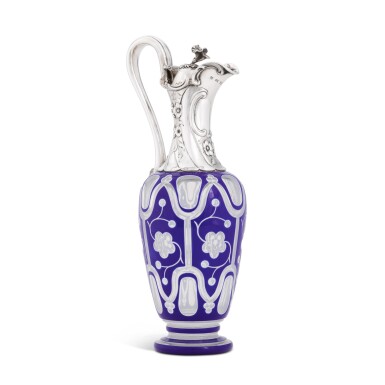
The Kent Collection of claret jugs
A Victorian silver-mounted glass claret jug, Charles Reily & George Storer, London, 1845
Lot Closed
November 8, 01:43 PM GMT
Estimate
4,000 - 6,000 GBP
Lot Details
Description
A Victorian silver-mounted glass claret jug
Charles Reily & George Storer, London, 1845
the clear glass body (possibly by Richardson) with double white and blue overlay in a floral strapwork pattern, the mount with chased and embossed floral decoration, the handle with Bacchus mask bracket,
height 35cm., 13 3/4in,
The present lot is illustrated in McConnell, A., The Decanter: an Illustrated History of Glass from 1650, Antique Collectors' Club 2004, p.440.
In his article, ‘Thomas Hyde and his successors’ (The Silver Society Journal, no. 10, London, autumn 1998, pp. 16-19), Brian Beet was able to show that the firm of Reily & Storer, well-known to collectors as silver wine label manufacturers, traced its origins to the elder Thomas Hyde (1725-1805). The latter had served his apprenticeship from 1739 with John Harvey, one of the earliest silver wine label makers. Of Hyde’s two sons, the elder, also Thomas, predeceased his father; the younger, James, also a wine label maker, entered his first mark in 1777. James died in 1799 and in 1801 his widow, Mary Ann, married his former apprentice, John Samuel Reily (d. 1826) by whom she had two sons and two daughters, including Charles Reily (6 July 1803 – 2 May 1893). Mary Ann and Charles entered a joint mark on 31 May 1826. Following Mary’s retirement at the end of 1828 Charles Reily went into partnership with George Storer (9 February 1797 – 19 February 1888) and together they entered a joint mark on 1 January 1829.
As Mr. Beet states, by the first years of the 19th century, the firm had diversified, producing not only wine labels, but a range of other smallwork, particularly snuff boxes. As Reily & Storer they expanded their production even further, such as making the Newcastle-upon-Tyne race cup of 1844, an equestrian group of two knights in armour. (Sotheby's, New York, 19 October 2017, lot 189)
You May Also Like


