Eddy Kamuanga Ilunga
Negbele 2
Auction Closed
March 21, 03:48 PM GMT
Estimate
40,000 - 60,000 GBP
Lot Details
Description
Eddy Kamuanga Ilunga
Congolese
b.1991
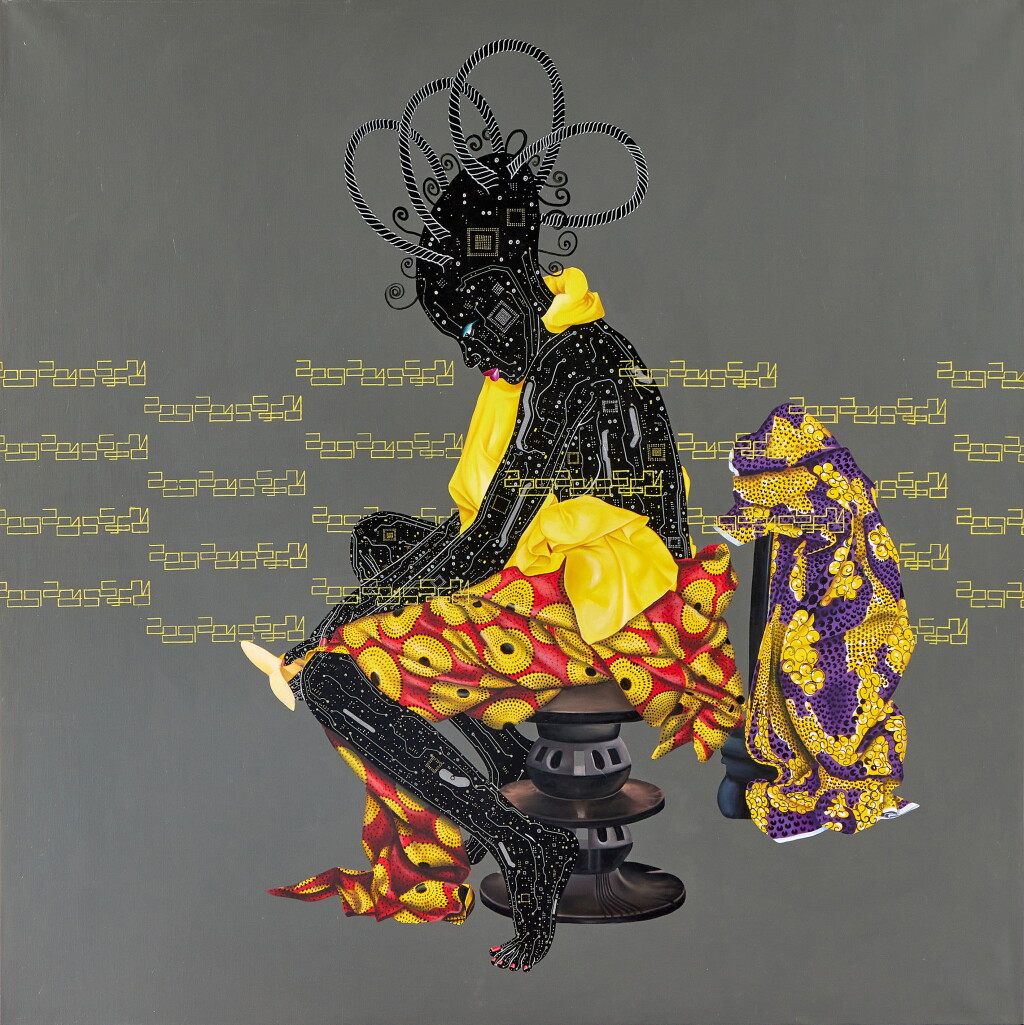
Negbele 2
oil and acrylic on canvas
196.5 by 196.5cm., 77⅜ by 77⅜in.
Executed 2015
Acquired directly from the artist by the present owner
‘I hope we can revive the traditional values from which we’ve become estranged. If so, there’s a real possibility of a different future.’
- The Artist, Smithsonian Magazine
Negbele 2 is a striking example of breakthrough contemporary artist Eddy Kamuanga Ilunga’s revered Mangbetu series, in which the artist explores the effects of rapid industrialization on the Mangbetu people from the north-eastern Orientale Province of the Democratic Republic of Congo. Hailing from Kinshasa, Africa’s third-largest urban area, Eddy Kamuanga Ilunga’s wider practice draws influence from an increasingly industrial and rapidly evolving technological world where historic ways of life and rituals of the Congolese people are under threat, resulting in a strain on communities resisting globalization in favor of maintaining cultural praxis associated with a bygone pre-colonial age.
To explore these tensions, the artist creates compositions which place traditional symbols and cultural practices in direct opposition with contemporary codes. The latter represented through the microchipped etched skin of the figures. The artist’s most recognizable trademark, this code unites his entire body of work and was developed as a reference to the abundance of coltan in the Democratic Republic of Congo, an ore crucial to the production of microchips used in smartphones. The artist’s motif also serves as a commentary on the destruction of many local settlements and villages in pursuit of this ore.
His first series, Mangbetu, for which the artist earned initial widespread acclaim in the West, makes this tension between tradition and modernity explicit in its reference to Lipombo, a tradition of head elongation practiced by the Mangbetu people, an ethnic group in the Northeastern part of the country. By depicting his futuristic microchipped figures with elongated heads, Kamuanga places the Lipombo tradition in direct contention with the onset of destructive technological growth.
This juxtaposition is further stressed through the presence of the elegantly rendered drapery of yellow Dutch wax cloth that surrounds his static figure. Though commonly serving as symbols of multi-layered cultural identity, Kamuanga's foremost intent is to exalt these textiles for their decorative splendor and their deep-rooted cultural ties to Africa's pre-colonial heritage. His figures’ elegant swerves of traditionally braided hair and the various traditional or locally grown objects they hold or wear all set against his digital patterning, reinforce Kamuanga’s quest to represent a Congo which is struggling to retain its indigenous cultural and social values amid unprecedented technological progress.
Kamuanga’s captivating figures present as heroic and hopeless in equal measure. His politically charged and culturally sensitive works are anthropological studies, a preservation and veneration of the Mangbetu for generations to come.
Eddy Kamuanga Ilunga's works can be found in the institutional collections of the Zeitz MOCAA, Cape Town, South Africa; the Hood Museum of Art, Hanover, USA; Pizzuti Collection of the Columbus Museum of Art, USA and the Norval Foundation, Cape Town, South Africa, amongst others.
You May Also Like