
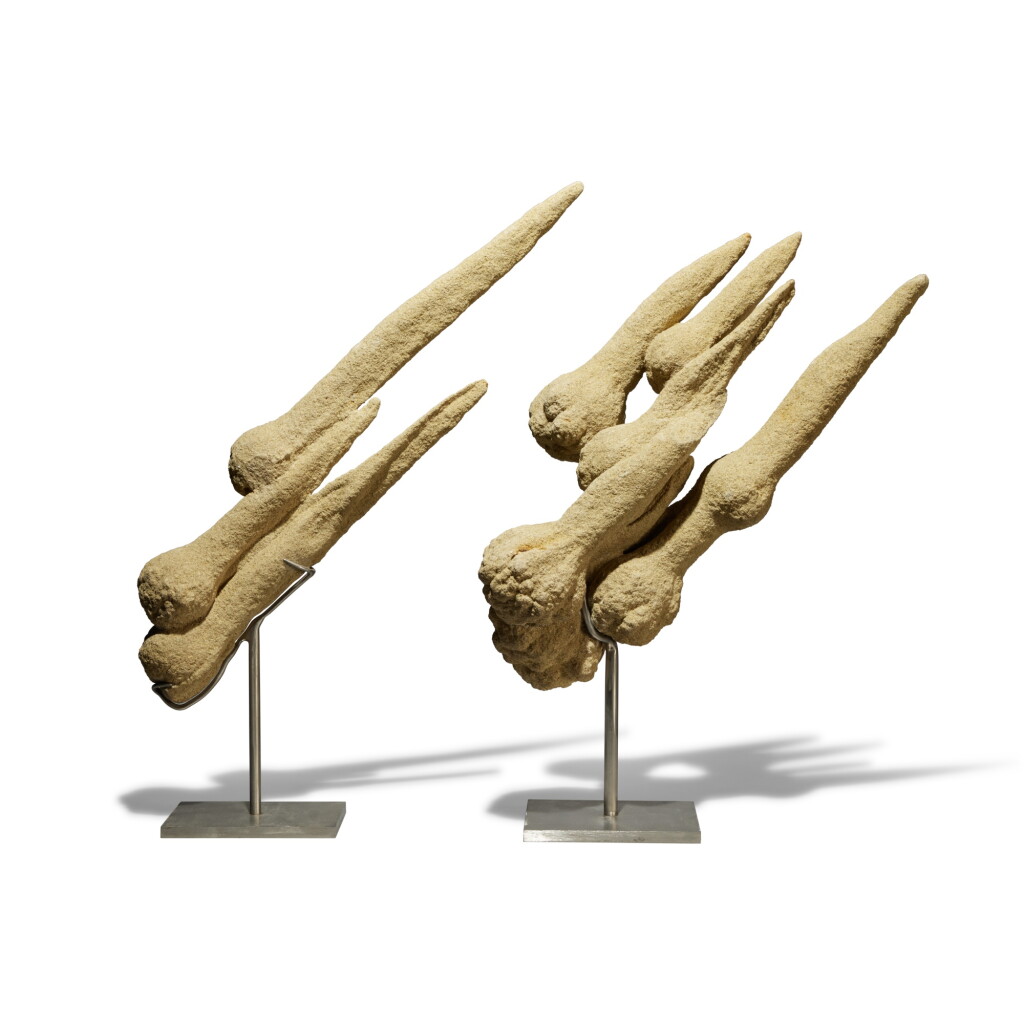
Pair of German Sand Spikes
Miocene Epoch (approx. 14.8 million years ago), Upper Freshwater Molasse, North Alpine Foreland Basin, Germany
No reserve
Auction Closed
July 16, 06:46 PM GMT
Estimate
3,000 - 5,000 USD
Lot Details
Description
Pair of German Sand Spikes
Middle Miocene, Langhian (approx. 14.8 million years ago)
Upper Freshwater Molasse, North Alpine Foreland Basin, Germany
The smaller set of spikes measures 22½ x 5 x 3 inches (57.2 x 12.7 x 7.6 cm), 22 inches (55.9 cm) tall on stand. Larger set of spikes measures 19½ x 9 x 7 inches (49.5 x 22.9 x 17.8 cm), 21 inches (53.3 cm) tall on stand. 27 pounds (12.2 kg) combined.
German Sand Spikes are a type of seismite, or a structure formed by seismic activity. In this case the cause was the asteroid that struck east of what is now Stuttgart, Germany, producing the Nördlinger Ries impact crater 14.8 million years ago. Sand spikes were created when violent shaking forced water out of wet sand, which then became heated to the point of explosion, creating a spike-shaped cavern that new sand rapidly filled in, and was then cemented over with calcite. The tails of these spikes grew away from the seismic activity, in the direction of wave propagation. As such, sand spikes all orient with their tails pointing away from the Nördlinger Ries crater in the North Alpine Foreland Basin in Southwest Germany.
Made up principally of quartz, feldspar, mica, and associated minerals, these German Sand Spikes bear a striking resemblance to sand spikes found near Mount Signal, west of the San Andreas Fault Line on the California-Mexico border. These sand spikes are also attributed to the seismic activity occurring in the area, and their tails also point away from the shaking caused by the tectonic fault. There are very few other places in the world where such sand spikes are found, making these rare and scarce objects.
The same meteoroid strike that produced these sand spikes also produced Moldavite tektites: see Lot 119.
REFERENCES:
Buchner, Elmar, Volker J. Sach, and Martin Schmieder. "Sand spikes pinpoint powerful palaeoseismicity." Nature Communications 12: 6731 (2021).

