
Property from the Collection of David H. Murdock
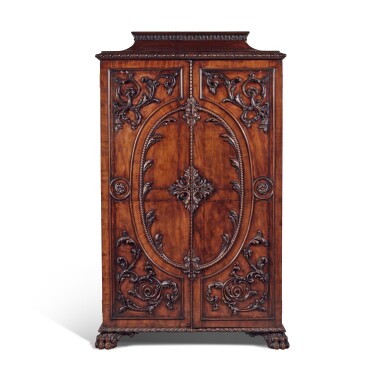
A George III Carved Mahogany Cabinet, of the model supplied to George III and Queen Charlotte in c.1763
No reserve
Lot Closed
April 14, 04:11 PM GMT
Estimate
6,000 - 10,000 USD
We may charge or debit your saved payment method subject to the terms set out in our Conditions of Business for Buyers.
Read more.Lot Details
Description
the arched cavetto moulded top with leaf-tip and leaf gadrooned borders, above two cabinet doors applied with rich acanthus scroll, flowerhead and foliate clasp relief carving; the lower border with bold gadrooning and raised on lion's paw feet; interior now fitted for shelves
height 70 in.; width 42 1/2 in.; depth 21 1/2 in.
178 cm; 108 cm; 54.5 cm
Christie's New York, 21 January 1999, lot 556
G.F. Laking, The Furniture of Windsor Castle, London 1905, p. 49
H. Clifford Smith, Buckingham Palace, London 1931, pp. 78-9, fig. 68
R. Edwards and M. Jourdain, Georgian Cabinet-Makers, London 1955, rev. ed., p. 155, fig. 67
A. Coleridge, Chippendale Furniture, London 1968, fig 16
This cabinet is of identical model to a set of nine in the Royal Collection, supplied to George III and Queen Charlotte in 1763. The set is believed to have been commissioned in conjunction with the alteration of an existing case for an upright harpsichord and organ (claviorgan) into a china cabinet, involving significant reconstruction and additions of new carving, by the court cabinetmaker William Vile (1740-1767) in 1763 for the ‘Japan Room’ in the Queen’s House (now Buckingham Palace). This organ case has often been associated with the cabinet thought to have been created in the 1740s for Frederick, Prince of Wales and attributed to Benjamin Goodison (RCIN 1366; illustrated in Jane Roberts, ed., George III and Queen Charlotte, Patronage, Collecting and Court Taste, London 2004, no.264 p.259), though documentary evidence for this is lacking, as are any invoices for the cabinets, which traditionally have also been ascribed to William Vile and are thought to have originally been designed to house organ rolls. Both the organ case and six of the cabinets appear in an 1819 watercolour of the Queen’s Gallery at Kensington Palace by James Stephanoff (1789-1874; RCIN 922155) that was engraved by W.H. Pyne in his Royal Residences (1817-1820), pl. 67. The organ cabinet remains in situ in the Queen’s Gallery, whilst seven of the cabinets, which had been placed between the window bays, were transferred to Buckingham Palace during the reign of Queen Victoria and two were recorded at Windsor Castle in c.1905 before being reunited with the other seven by Queen Mary in the early 20th Century.
The elaborate scrolls, circular and oval central borders and foliate clasps on the cabinets and organ case are comparable to carved work appearing on other large pieces of mahogany case furniture supplied to George III and Queen Charlotte in the early 1760s by Vile and his partner John Cobb (d.1778), including the monumental bookcase made for the Queen’s Bedroom at Buckingham House (RCIN 252) and the China Cabinet sent in c.1761 to the Bow Closet in St James’s Palace, which left the Royal Collection by the early 20th Century and was most recently in the Ann and Gordon Getty Collection (sold Christie’s New York, 20 October 2022, lot 39). The carving on both these pieces may have been subcontracted to the specialist woodcarver Sefferin Alken (fl.1744-83), who also worked with the architects William Chambers and Robert Adam, and is somewhat bolder and more voluminous in manner when compared to the carving on the set of cabinets. Interestingly, very similar oval borders with a central leaf quatrefoil across the doors in a lighter style appear on a pair of commodes probably supplied to Kirtlington Park and now in the Gerstenfeld Collection (illustrated E. Lennox-Boyd, Masterpieces of English Furniture. The Gerstenfeld Collection, London 1998, p.115 pl.89 and p.192 no.3) and a single commode previously with Norman Adams and Jeremy and most recently in the Tavitian Collection (sold Sotheby’s New York, 8 February 2025, lot 1188). These have been attributed to Vile’s workshop assistant John Bradburn (d.1781), who succeeded his master as ‘Upholsterer to his Majesty and Cabinet-Maker to the Great Wardrobe’ following Vile’s retirement in 1764. In partnership with William France (1727-1773), also a journeyman from Vile’s workshop, Bradburn provided a significant quantity of furniture to the royal palaces between 1764 and 1777, and as such is also a potential candidate for the authorship of the cabinets.
A further cabinet of identical model to the offered lot and the nine cabinets in the Royal Collection was sold recently at Rouillac, Château d'Artigny, Montbazon, France 20 June 2022, lot 379.