Tiffany Studios
An Early Vase
Auction Closed
December 8, 12:02 AM GMT
Estimate
8,000 - 12,000 USD
Lot Details
Description
Tiffany Studios
An Early Vase
circa 1897
Favrile glass
engraved L.C.T. E1433 with the firm’s paper label
7½ in. (19 cm) high
12 in. (30.5 cm) maximum diameter
American Antiques, Appraisals, Auction Service, Keene Valley, New York, August 16, 1986, lot 66
A Gaffer's Experiment: The Early Vase
This early vase, reputedly from the former collection of Robert and Emily Weeks DeForest, is as unusual as the DeForest-owned vase offered in the June 2023 auction of the Doros Collection (lot 346). While both are decorated with stylized plumage, that might be their only similarity. The previous offering was small, transparent, flawlessly manufactured, lacked iridescence and was decorated with colorful orange, violet and purple feathers.
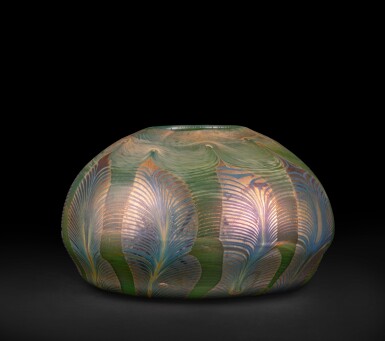
This impactful example is the antithesis: it is of an opaque glass primarily in shades of green with additional white swirls from the shoulder to the top rim. Encircling the body are slender waves, the lower ones with a bright gold and violet iridescence and the upper waves of uniridized olive-streaked cream. Intersecting these waves are a band of large violet and gold iridescent feathers with cream and caramel shafts. After completion, the vase was fumed with acid to give it a silky matte finish. Those adventurous enough to examine the underside of the vase will discover a decoration equally as striking as that on the body.
Although not apparent when viewing the exterior, the interior shows evidence that the gaffer and his team had great difficulty in creating this vase. There are several large and distinct threads encircling the inside, some in considerable relief. Objects with this type of apparent imperfection would never have been allowed to leave the glasshouses of Tiffany’s later competitors, such as Steuben or Quezal. For Tiffany and his craftsmen, however, this highly unusual vase was apparently of sufficient aesthetic appeal to be sold, even to one of his most important and influential patrons.
- PD