
Tiffany Studios
"Agate" Vase
Auction Closed
December 8, 12:02 AM GMT
Estimate
8,000 - 12,000 USD
Lot Details
Description
Tiffany Studios
"Agate" Vase
circa 1895
Favrile glass
engraved Louis C. Tiffany C195
4⅜ in. (11.1 cm) high
A Polished Gemstone: "Agate" Glass
Tiffany’s love of nature extended to his fascination with gems and stones, a fondness enhanced by his many trips as a child to Tiffany & Company. He readily employed semi-precious stones in some of his earliest commissions and continued to do so for many of his firm’s interior design projects. This fascination is also revealed in his glasshouse’s highly successful attempts to imitate the sliced and polished sections of agates. Tiffany was probably further influenced by his knowledge that agates were frequently used as a decorative element by the ancient Greeks and Romans.
Tiffany was hardly the first person to attempt imitating cut agate in glass; that honor belongs to Friedreich Egermann, a Bohemian glassmaker, and his Lithyalin glass that first appeared in 1829. Tiffany’s Favrile Agate glass, however, came the closest to replicating the actual appearance of the sliced sections of striated and banded agate. The first attempts at manufacturing Agate glass were used in the sheet glass for the Tiffany Glass and Decorating Company’s early leaded glass windows. The glass was adapted for blown vessels shortly thereafter and Agate vases were produced until the mid-1920s.
An October 1895 article in the Brooklyn Daily Eagle, in reviewing the recent work of the Tiffany’s glasshouse, described a group of vases where “glass of different hues is welded together and threaded with bands, some of them with great delicacy, with an effect not unlike that of agate.” The vase offered here was made that same year and, as such, is an exceptionally early and rare example.
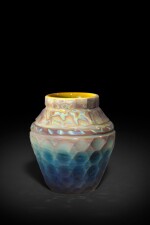
Both its composition and design are highly unusual. The opaque body has a lower section of navy and cobalt streaked with chartreuse and green. This extends to a shoulder in shades of butterscotch, teal and caramel and finally to an almost psychedelic neck in the same colors but with the addition of a bright yellow inner lining. Equally unusual is the cutting. Most Agate vases are simply panel cut, with broad flat bands extending from top to bottom. That is true of this piece, but only of the neck. The lower half of the body is surprisingly cut in a honeycomb pattern, an effect the glasshouse apparently never repeated in another piece of Agate. This vase is another spectacular example of the experimentation in both glass and technique displayed by many of Tiffany’s earliest Favrile pieces.
- PD