
Tiffany Studios
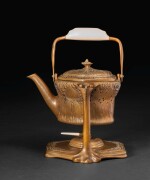
"Dragonfly and Arrowhead" Teapot and Stand
Auction Closed
December 8, 12:02 AM GMT
Estimate
15,000 - 20,000 USD
Lot Details
Description
Tiffany Studios
"Dragonfly and Arrowhead" Teapot and Stand
circa 1902
gilt and enameled bronze, ivorine
kettle impressed TIFFANY STUDIOS/NEW YORK/S309
stand and burner each impressed TIFFANY STUDIOS/NEW YORK/S310
10½ x 8½ x 8½ in. (26.7 x 21.6 x 21.6 cm) as pictured
Hugh McKean, The "Lost" Treasures of Louis Comfort Tiffany, New York, 1980, p. 233, fig. 232
"Beauty is Everywhere": Decoration in All Objects
Tiffany Studios and its immediate predecessor, the Tiffany Glass and Decorating Company, are perhaps best known for their leaded glass lamps and windows. Louis Tiffany, however, was at one time this country’s leading interior decorator and his work was acclaimed for its eclectic and exotic, yet surprisingly cohesive, schemes. It is therefore no surprise that Tiffany Studios also attempted to become America’s leading supplier of all aspects of decorative furnishings. Although the company started primarily as a glasshouse, it quickly established facilities to produce an incredibly wide variety of objects, ranging from textiles and rugs to metalwork, furniture and even cabinetry. Foremost among these “accessories” were the pieces designed and made by its Fancy Goods Department.
The company’s use of the term “Fancy Goods” initially appears in their 1906 Price List, however objects that fall under that category were first made almost a decade earlier. The department responsible for designing these objects was led by Clara Driscoll (1861-1944). Driscoll was the Head of the company’s Women’s Glass Cutting Department and by 1899 was responsible for “all the portable objects in Favrile glass and metal combinations.” She and the rest of the “Tiffany Girls” under her leadership proved to be extremely adept at creating innovative designs that soon took full advantage of all the manufacturing skills and capabilities of the company. Louis Tiffany’s role in the department’s artistic and commercial success, however, should not be minimized. He was, after all, in the forefront of hiring women for design work and production. Furthermore, Tiffany was responsible for approving all the designs and it was his love of nature, and his belief that all “true” art was based upon nature, that inspired the vast majority of his companies’ decorative motifs.
Driscoll, with Tiffany’s aesthetic and financial support and the skill of the company’s metalsmiths, quickly expanded the number and variety of fancy goods. Among the rarest of those creations are the teapot and cigar lighter offered here. Driscoll is generally credited with the design, as it has some similarities with her Dragonflies and Water Flowers leaded glass lamp shade. But it is possible that another of the Tiffany Girls was responsible, as Driscoll wrote in early 1902 that Alice Gouvey had recently designed a clock “made of dragonflies and arrowhead flowers.”
Whoever was responsible for the motif, they were likely inspired by the French artist Eugene Grasset (1845-1917). He published in 1896 La Plante et ses applications ornementales in which were printed 48 colored lithographs of flowers and floral designs. Plate 26 pictured stylized flowering arrowhead plants and the teapot and cigar lighter bear a striking resemblance to Grasset’s drawing. The teapot has a body superbly crafted with large arrowhead leaves, flowers and achenes. The fitted cover is covered with overlapping dragonflies, apparently hovering over the aquatic plants. The teapot is raised on a stand crafted with a matching design and two vertical supports terminating with dragonflies. Both the teapot and the companion cigarette lighter are enhanced with enameled highlights.
Louis Tiffany expressed the crux of his artistic philosophy in 1917: “The most beautiful thing I can think of is to show people that beauty is everywhere, wherever we go, that it is uplifting, that it is health giving, universal in its appeal and, while we may not be able to select any one class of scenes or objects that completely satisfy, the search for beauty is in itself the most wholesome of all quests.” Objects such as the two offered here typify his desire to bring beauty to even the most prosaic of tasks.
- PD
You May Also Like


