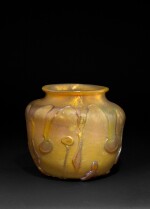

Tiffany Studios
"Lava" Vase
Auction Closed
December 8, 12:02 AM GMT
Estimate
10,000 - 15,000 USD
Lot Details
Description
Tiffany Studios
"Lava" Vase
circa 1904
Favrile glass
engraved L.C.T. 8295A with the firm’s paper label
4⅝ in. (11.7 cm) high
Paul Doros, The Art Glass of Louis Comfort Tiffany, New York, 2013, p. 125 (for the present lot illustrated)
Fused With Gold: A Rare White "Lava" Vase
Tiffany Studios’ so-called Lava vases are exceptionally rare for primarily two reasons. First, they were incredibly difficult to produce from a technical aspect, with many either cracking or completely shattering during the annealing process. Secondly, the examples that did survive were perhaps too outré for even the most adventurous of the company’s clients.
Apparently produced only in 1906-1907 and again around 1916, it was originally theorized that the lava motif was inspired by Louis Tiffany’s observation of Mt. Aetna erupting during one of his many European trips. That story, however, has been proven to be apocryphal. A far more likely design source can be found in Tiffany’s love of Japanese art, which had a significant influence on much of his aesthetics. It is highly probable that the direct inspiration for his Lava vases was his familiarity with the Japanese restoration technique of kintsugi, or “golden joinery.” Originating in 15th century Japan, this method of repairing broken ceramic vessels involved using thick, irregular gold seams to make the piece whole and even more treasured than when it was originally created.
The vases made during the above-mentioned periods generally feature similar elements: asymmetrical bodies with uneven, slightly undulating rims and multi-hued exterior iridescences; navy-cobalt overlays, with a texture like weathered leather, interspersed with irregular patches exposing the transparent yellow ground; and iridescent gold threadings and applications of varying dimensions and thicknesses dripped around the body.
The example offered here is a precursor to those vases and offers another intriguing hint to the long evolution of the Lava style. Created around 1904, this vase is made of opaque white glass, not transparent yellow, with an overall irregular gold iridescence that was unevenly applied. A band of transparent yellow glass was additionally applied around the shoulder from which emanate long thick drips with globular endings. Similar shorter tendrils originate at the base and extend slightly upwards. These applied drippings were given a bright gold iridescence that is slightly stretched upon close examination.
This vase is one of the earliest and rarest examples of Lava known. Its rarity is likely a result of the excessive technical issues that were involved in its production, or perhaps Louis Tiffany, his gaffers or Tiffany’s clients simply preferred the aesthetics of the gold over navy motif that would be introduced a short time later.
- PD