
Tiffany Studios
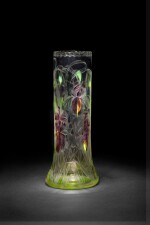
"Iris" Cameo Vase
Auction Closed
December 8, 12:02 AM GMT
Estimate
15,000 - 20,000 USD
Lot Details
Description
Tiffany Studios
"Iris" Cameo Vase
circa 1895
Favrile glass
engraved L.C.T. X2401
11¼ in. (29.2 cm) high
Exceptional Engraving: The Work of Fredolin Kretschmann
The incredible lot offered here is undoubtedly the work of Fredolin Kretschmann (1845-1898), generally acknowledged as one of the finest glass engravers of his generation. A native of Austria and the son of an engraver, he and the entire Kretschmann family moved in 1864 to Stourbridge, England, where he learned and mastered his craft. He received numerous prestigious awards throughout Europe, including the French Legion of Honor and recognition from King Ludwig of Bavaria and Emperor Francis Joseph of Austria.
Kretschmann sailed from London to New York City in October 1891 and was soon joined by his wife. Although a newspaper account asserted that the couple left Europe due to family opposition to the marriage, it is more probable Kretschmann wanted to explore what employment opportunities existed in the United States for a man with his talents. Louis Tiffany hired him to work for the Stourbridge Glass Company, supposedly after seeing his work at the 1893 Columbian Exposition. Kretschmann’s reputation was such that his engraved Favrile vases sold for as much as $1,500 to clients that included the Goulds, Vanderbilts and Havemeyers. Kretschmann unfortunately died suddenly and unexpectedly at his modest home in Corona, New York on August 6, 1898.
This vase is a testament to Kretschmann’s exceptional skills. The lead-based transparent glass was enhanced with padded and slightly marvered sections of purple and green irregularly placed around the body, as well as smaller patches of bright yellow, while the gather was still hot and on the blowpipe. After being shaped and annealed, the vase was then brought to Kretschmann’s “small room” at the Tiffany Glass and Decorating Company where he had his workbench. The green sections magically became tall, slender leaves and the purple areas were superbly carved into irises, some having yellow centers. The design was then completed with the addition of more finely engraved leaves and flower petals. The draped band of engraving around the top rim was the finishing touch. It was pieces such as this one that caused the glasshouse to bemoan that Kretschmann’s “work was almost unique, and whose recent death has created a vacancy which is found almost impossible to fill.”
- PD