Tiffany Studios
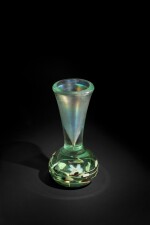
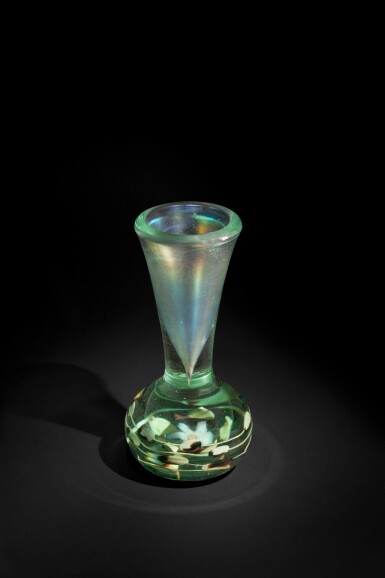
"Aquamarine" Vase
Auction Closed
December 8, 12:02 AM GMT
Estimate
30,000 - 50,000 USD
Lot Details
Description
Tiffany Studios
"Aquamarine" Vase
circa 1914
Favrile glass
engraved L.C. Tiffany Favrile 258J with the firm’s paper label
9¾ in. (24.8 cm) high
Ray and Lee Grover, Art Glass Nouveau, Rutland, Vermont, 1967, p. 99, pl. 183 (for a related example)
Hugh McKean, The “Lost” Treasures of Louis Comfort Tiffany, New York, 1980, p. 162, fig. 156 (for the above mentioned related example)
Paul Doros, The Art Glass of Louis Comfort Tiffany, New York, 2013, p. 153 (for the present lot illustrated)
The Underwater Effect: "Aquamarine" Glass
Aquamarine glass was one of the last innovations introduced by Tiffany Furnaces. In July 1913, Tiffany sent Arthur E. Saunders (1873-1951), a gaffer who had been with the glasshouse since 1897, to Hamilton, Bermuda to examine the marine life and vegetation in the surrounding tropical waters from a glass-bottomed boat. The intent was for Saunders to replicate, in glass, what he saw when he returned to Corona. The result, after a surprisingly short period of experimentation, were Aquamarine vases that were met with immediate critical success. Featuring thick, heavy bodies of transparent, green-tinted glass encasing a highly naturalistic motif, the pieces were highlighted in magazine articles and Tiffany & Company’s Blue Book from 1914 to 1917 with some priced as high as $300. This exorbitant price was an indicator of how exceptionally difficult it was for the glasshouse to produce these objects, some of which weighed as much as 25 pounds. Even after the gaffer had successfully finished his role, many examples shattered and broke while being annealed.
The example offered here, likely from the earliest group of Aquamarine vases, is indicative of how quickly Saunders mastered the complicated and challenging technique. The spherical body encloses a single white-petaled water lily with a red, crimson and yellow center. The flower is encircled by thin wavy blue and beige vines and matching plum-brown tipped leaves that are apparently trapped in a gentle circular current. The underwater effect is further heightened by the addition of a few trapped air bubbles and subtle striations within the glass.
- PD
You May Also Like


