
Omega
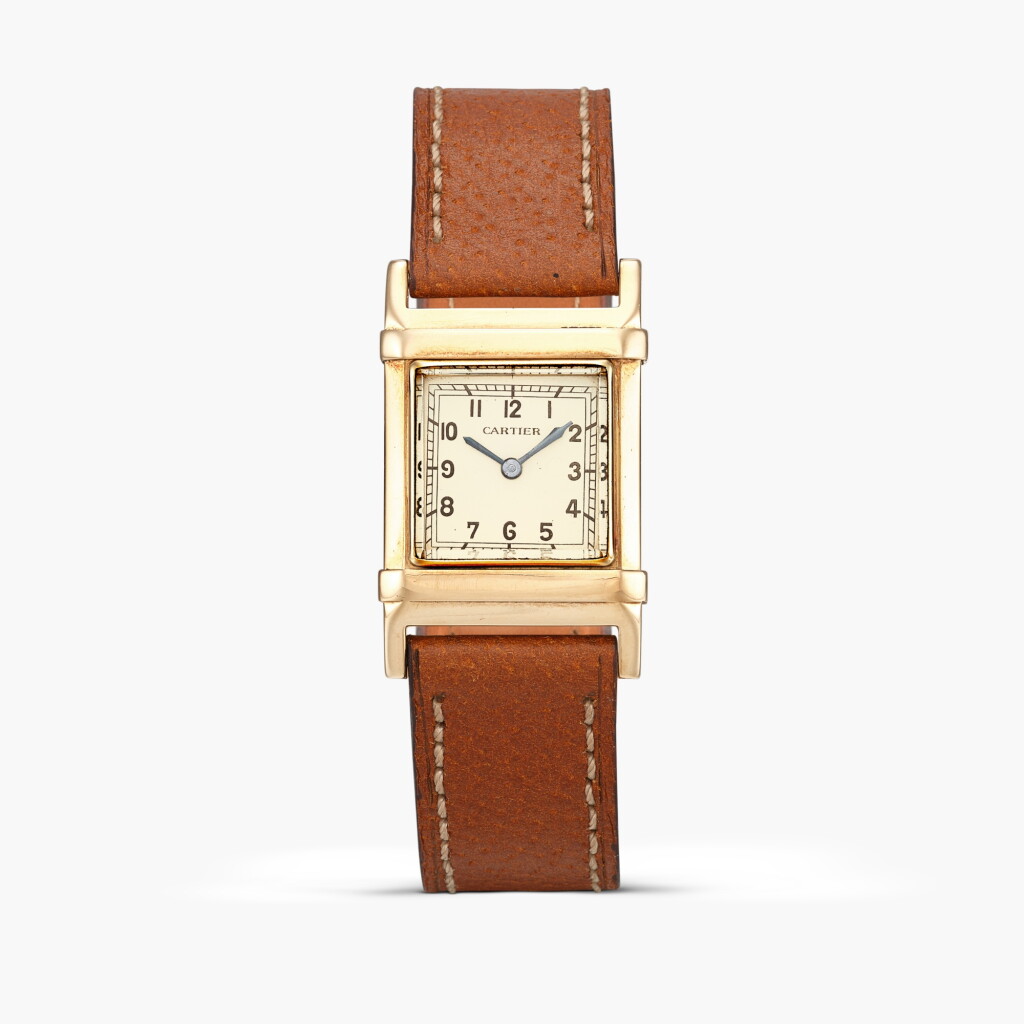
Retailed by Cartier New York | A rectangular yellow gold ‘waterproof’ wristwatch, Circa 1937-40
Auction Closed
September 19, 06:56 AM GMT
Estimate
120,000 - 200,000 HKD
Lot Details
Description
Omega
Retailed by Cartier New York
A rectangular yellow gold ‘waterproof’ wristwatch, Circa 1937-40
Dial: silvered dial signed Cartier, black Arabic numerals, outer minute track, blued steel hands
Calibre: 9’’’ circular Omega calibre 19.4 movement, grained finish, OXG import code for U.S.A., lever escapement, 17 jewels, bi-metallic compensation balance with timing and poising screws, Breguet hairspring, unadjusted, signed Omega
Movement number: numbered 9’073’628
Case: 14k yellow gold case; outer gold case: flat sapphire crystal with chamfered edge set within a slim raised bezel, faceted case sides, hooded lug to upper section and hinged clip to back for affixing to inner case (back of clip numbered 54 and with Swiss squirrel assay); inner gold case: chamfered bezel, synthetic flat crystal, notched crown, second hooded lug below 6 o’clock, winding crown above 12 o’clock, sliding into the outer case
Case number: lower right lug stamped 6'850, both case halves interiors signed Omega, numbered 9’974’954 and with Swiss squirrel assay mark for 14k gold, Poinçon de Maître key mark 2 for Baumgartner, outer case stamped with patent numbers: Swiss patent 146'310, French patent 710'316, British patent 365'356, U.S.A. patent 1'907'700, German patent 567'213
Closure: brown unsigned leather strap and modern 18k yellow gold deployant buckle stamped Cartier, Swiss Made and with Swiss assay marks
Size: 36 mm length x 22 mm width
Accessories: Cartier presentation box
The Marine, introduced in 1932, was the first wristwatch to be officially tested and certified for diving. In 1936 the Omega Marine was tested by immersion in Lake Geneva to a depth of 73 metres, returning to the surface unharmed and in working order. A year later, in 1937, the Marine was officially tested to withstand pressure of 13.5 atmospheres, the equivalent of 135 metres, at the Swiss Laboratory for Horology in Neuchâtel.
The Marine’s case, which was adapted from designs by Louis Alix registered under Swiss patent 146'310 of 7 March 1931, is composed of two main parts. Effectively the watch is in two halves and clamped together by means of a clip to the back of the case. The main body of the watch, which houses the dial and movement, slides into the outer case and, by means of internal gaskets, a watertight seal is achieved. To wind and set the watch, the clip to the back is undone and the two case halves are separated from one another, thereby giving access to the winding crown.
Glasses that were not shaped in the round were especially difficult to waterproof, and in order to achieve a strong and tight seal around the dial aperture of the Marine’s outer case, a sapphire crystal was used. This was one of the first applications of this type of glazing in a wristwatch and at the time was advertised as being nine times as strong as glass. Steel versions of the watch were fitted with waterproof straps made of seal skin and had a special folding clasp. The cases were made for Omega by the specialist case makers F. Baumgartner, the company’s Poinçon de Maître key mark can be found inside the case back (key 2).
A small number of Omega Marine models were made for Cartier New York. This watch has a Cartier stock number to the underside of the lower right lug and an OXG Omega import code for the U.S.A. engraved and gilded to the movement.
歐米茄
由卡地亞紐約發行
長方形黃金「防水」腕錶,約1937至1940年製
附帶盒子