
Cartier
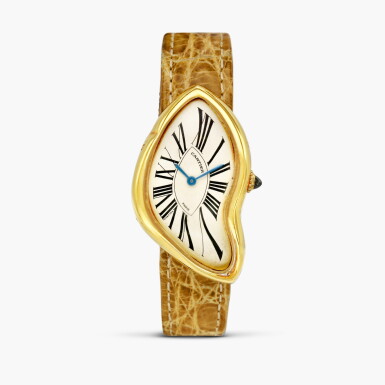
Crash ‘Paris’ | A limited edition yellow gold wristwatch, Circa 1991
Estimate
1,600,000 - 2,400,000 HKD
Lot Details
Description
Cartier
Crash ‘Paris’
A limited edition yellow gold wristwatch, Circa 1991
Dial: white
Calibre: cal. 160 mechanical, 17 jewels
Case: 18k yellow gold, case back secured by 4 screws
Case number: limited edition 290-91 and A108586
Closure: tan Cartier alligator strap and 18k yellow gold Cartier Crash buckle
Size: 38.5 mm length x 22.5 mm width
Signed: case, dial and movement
Accessories: none
By now, everyone knows the Crash, and everyone knows the famous legend behind its creation. Perhaps the most instantly recognisable, iconic and disruptive shape ever designed not just by Cartier but by any watch manufacturer, the tale goes that a Baignoire wristwatch became badly mangled and distorted after being involved in a fiery car crash. When the watch was brought back to Cartier London for servicing, instead of repairing the watch, the watchmakers were instead greatly inspired by the design. Though intriguing and dramatic, this tale is unfortunately no more than an urban myth.
To fully understand the Crash, one must first understand Cartier London. In the same footprint as the present day Bond Street boutique, there stood a very different building over a century ago. Despite gaining acclaim in the watch community for their work in the 60s, Cartier on Bond Street first opened its doors long before then in 1902, but with most of its operations revolving around jewellery. However, unknowingly to anyone at the time, including those working at Cartier, the groundwork was already being laid for what was to follow. The top floor of the Bond Street building, then more of a townhouse than a luxurious retail space, was not dedicated to sales or clients, but instead was a true melting pot-style workshop. The entire design process, from the initial client commission, to sketching, to crafting, to finishing, was often done all on Bond Street with the help of enlisted goldsmiths, jewellers and craftsmen. From the start, Cartier London was not just independent and autonomous, but also lean and maneuverable with the times. Only in a setting like this could a truly radical design be born.
For the first half-century, Cartier London would only sell wristwatches imported from their French or Swiss manufacturers. However in 1964, the Cartier branches of New York, Paris and London were split up after the death of Pierre Cartier, which resulted in even more autonomy on Bond Street, just in time for the Swinging Sixties. The new head of the London Branch, a young fourth generation family man named Jean-Jacques Cartier, decided that they should begin producing watches locally. At the same time, a tidal wave of rebellion, freedom and counter culture was sweeping through London, a product of the pent up emotion from the post-war slump that had just passed. Cartier always had a way of distilling the essence of the period into their classic designs, and if the Tank was a symbol of the Roaring Twenties or Les Années Folles, then the Crash is the definitive icon of the Swinging Sixties.
Jean-Jacques Cartier had always preferred spending time in the upstairs workshop than downstairs in the showrooms, and he knew he wanted to make a watch with both the rebellious spirit of the period, but still elegant and chic enough to be worthy of the Cartier name. He started with the Oval, one of London’s most popular cases, and by pinching the ends and putting a kink in the middle, a new radical shape was slowly born. Several prototype shapes and dials were created by his closest collaborator and designer Rupert Emmerson, one of them even featuring a cracked dial to simulate the effect of an actual “crashed” watch. Indeed, what they eventually arrived at was a watch that looked every bit the part like it came from a car crash, but in reality, was an entirely and meticulously intentional creation. Jean-Jacques Cartier and Rupert Emmerson had not only achieved their ode to the Swinging Sixties, they created a brand defining masterpiece.
The Crash, as a result, must be seen as a product decades in the making, encompassing all of the factors which made Cartier London special. Not only is the design timeless, beautiful and as disruptive as the day it was launched, it is intrinsically tied to the most soulful Cartier location of all. Starting from the very foundation of the Bond Street branch, where Cartier London’s autonomous attitude was first established, to the splitting up of the regional branches, to Jean-Jacques’ decision to start making their own wristwatches, to the Swinging Sixties, the history of the Crash is the history of Cartier London. This heritage and spirit can be felt in every single example.
---
Although Cartier has created numerous iconic model lines across its famed history, the Crash is indisputably its most disruptive model produced. The exaggerated design epitomizes the defiant attitude of the 60s and will later become a symbol of creative freedom and non-conformism.
Known collectively by the watch community as the “Paris Crash”, the present example was the first Crash that was offered by Cartier after its initial unveiling in their London boutique in 1967. Its limited production run only saw around 400 of these examples ever made. Cased in 18k yellow gold, this iteration of the Crash is coveted for its Paris signed dial.
The case of the present example, which to many is the focal point of the watch, has oxidised handsomely over the years, which implies that it has not seen a polishing wheel for years, maybe decades. Favorite among actors and creatives, from Tyler the Creator to Timothée Chalamet, the Cartier Crash has certainly cemented itself as a grail of grails.
卡地亞 Crash ‘Paris’
限量版黃金腕錶,約1991年製
時至今日,卡地亞 Crash 腕錶早已人盡皆知,其問世背後的傳奇故事亦廣為流傳。作為不僅是卡地亞,甚至可說是整個鐘錶產業史上最具辨識度、最具標誌性且最具顛覆性的設計之一,據傳,一枚 Baignoire 腕錶在遭遇一場嚴重車禍後,被擠壓得扭曲變形、面目全非。當這枚腕錶被送回卡地亞倫敦分部維修時,製錶師非但沒有著手修復它,反而深受其變形外觀所啟發,從而創造出這款經典外形。然而,儘管這個故事扣人心弦、戲劇性十足,卻終究不過是一則坊間傳聞。
若要真正理解 Crash,首先必須了解卡地亞倫敦分部的歷史。如今邦德街旗艦店所在地,一個世紀前矗立著一棟截然不同的建築。儘管卡地亞倫敦因其 1960 年代的製錶作品而在鐘錶界享譽盛名,但其邦德街店早在 1902 年便已開業,當時大部分業務仍以珠寶為主。然而,包括卡地亞員工在內,當時沒有人意識到,一切日後發展的基礎其實已悄然奠定。邦德街建築的頂層與其說是豪華的零售空間,不如說是一幢連排別墅;那裡並非用於銷售或接待客戶,而是一個真正的大熔爐式工坊。從接受客戶委託、草圖設計、製作加工,到最後的精修,整個設計流程往往都在邦德街內完成,並由所聘的金匠、珠寶匠與金屬工藝師共同協作。從創立之初開始,卡地亞倫敦便擁有高度的獨立性與自主權,同時又保持精簡靈活,能迅速回應時代變化。只有在這樣的環境中,才有可能孕育出真正激進且突破性的設計。
在最初的半個世紀裡,卡地亞倫敦所銷售的腕錶均由法國或瑞士的卡地亞製造商供應。然而,1964 年皮耶・卡地亞(Pierre Cartier)逝世後,紐約、巴黎與倫敦三大卡地亞分支正式拆分獨立,這使邦德街分店獲得更大的自主權,而此時恰逢「搖擺六十年代」(Swinging Sixties)的來臨。倫敦分公司新任掌舵人尚-雅克・卡地亞(Jean-Jacques Cartier)是一位年輕且富有想法的人,他決定開始在倫敦本地生產腕錶。與此同時,由戰後長期經濟低迷所積累的情緒終於爆發,一股反叛、自由與反主流文化的浪潮正席捲整個倫敦。卡地亞向來擅長將時代精神提煉並融入其經典設計之中。如果說 Tank 是咆哮的二十年代(Roaring Twenties)或「瘋狂年代」(Les Années Folles)的象徵,那麼 Crash 無疑就是搖擺六十年代當之無愧的標誌性符號。
尚-雅克・卡地亞向來喜歡待在樓上的工坊,而非樓下的展廳。他深知自己想創造一款既能展現當時叛逆精神,同時又足夠優雅時尚、不負卡地亞之名的腕錶。他以倫敦最受歡迎的錶殼設計之一「Oval」為起點,透過將兩端收窄,並在中央加入彎折變形的線條,一種前所未見的大膽輪廓逐漸誕生。在他最親密的合作夥伴兼設計師魯珀特・艾默森(Rupert Emmerson)的協助下,多款原型錶殼與錶盤設計相繼問世,其中甚至配有裂紋錶盤,以模擬真正「撞毀」腕錶的視覺效果。的確,他們最終呈現出的作品看起來宛如車禍造成的變形產物,但事實上,這一切都是精心策劃、有意為之的創作。尚-雅克・卡地亞與魯珀特・艾默森不僅成功向搖擺六十年代致敬,更共同創造出了一件定義品牌歷史的傑作。
因此,Crash 應被視為一項歷經數十年醞釀而成的成果,它凝聚了所有使卡地亞倫敦與眾不同的元素。其設計不僅雋永優美,而且至今仍如問世之日般顛覆傳統。更重要的是,它與最具靈魂的卡地亞據點有著深刻而內在的聯繫。從邦德街分店奠定卡地亞倫敦自主精神的基礎,到各區域分支的拆分;從尚-雅克決定自行製造腕錶,到整個搖擺六十年代的文化浪潮,Crash 的歷史其實就是卡地亞倫敦的歷史。這份傳承與精神,至今仍能在每一枚 Crash 腕錶之中清晰感受到。