
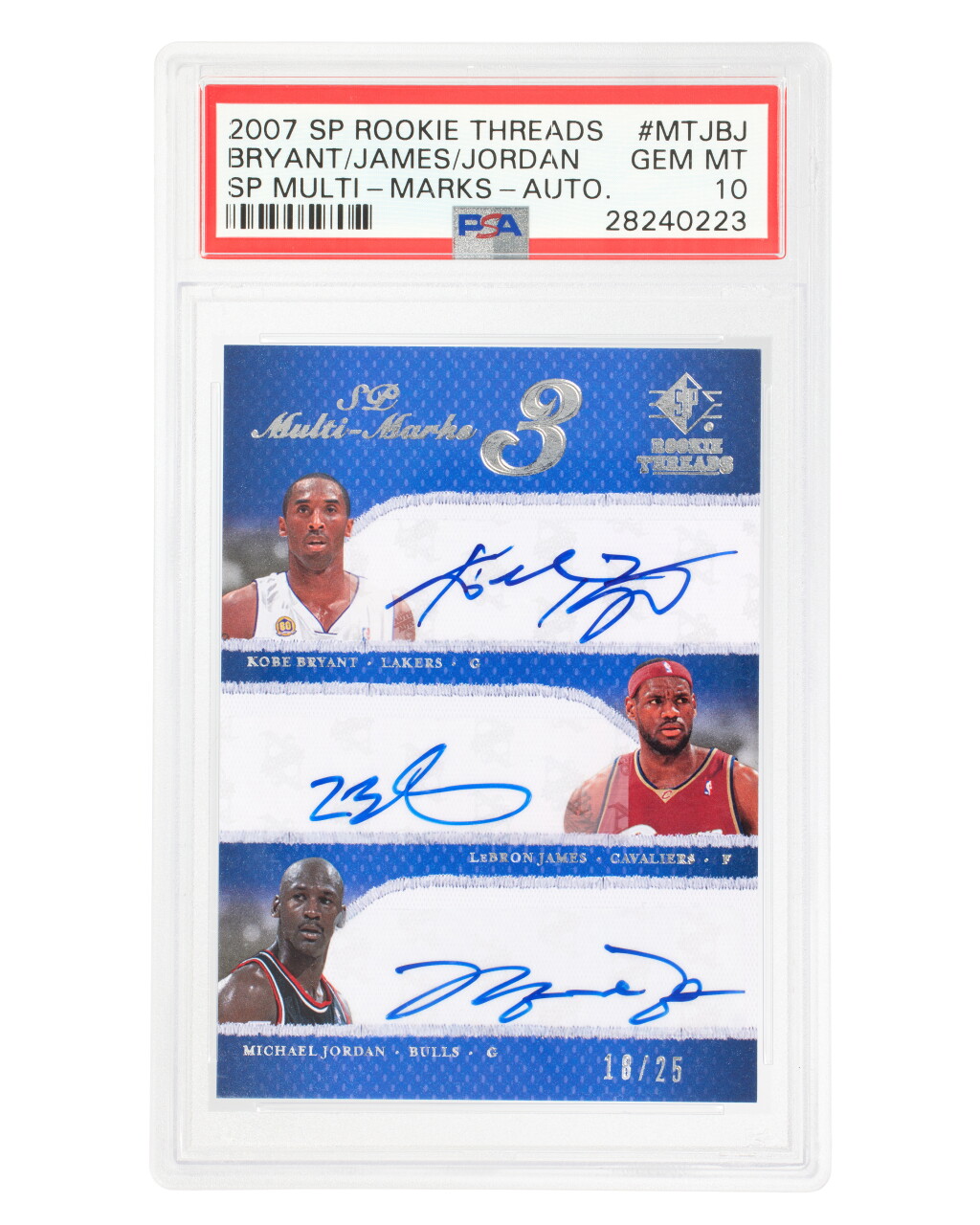
Michael Jordan, LeBron James, Kobe Bryant 2007-08 Upper Deck NBA SP Rookie Threads SP Multi-Marks Triple Autograph 18/25 #MT-JBJ PSA 10
No reserve
Lot Closed
April 22, 02:02 AM GMT
Estimate
Upon Request
We may charge or debit your saved payment method subject to the terms set out in our Conditions of Business for Buyers.
Read more.Lot Details
Description
Professional Sports Authenticator, PSA, 10 Gem Mint, sealed plastic holder, Cert number: 28240223
Cardboard and Plastic
Out of about 140 examples of this trio’s triple autographed cards across products to Sotheby’s knowledge, this is one of only two to have received the highly coveted PSA 10 grade at the time of cataloging. At the time of writing, and to Sotheby’s knowledge a triple autograph of this legendary trio in which the card has been graded a PSA 10 has never publicly come to auction.
This card was released on April 29, 2008 in the debut release of SP Rookie Threads for basketball, right in the heart of Kobe and LeBron’s careers and while the memory of Michael Jordan’s extraordinary talents were still fresh on the minds of basketball fans everywhere. Two days after LeBron had led his Cavaliers to a 3-1 series lead against the Washington Wizards in the first round of the 2008 NBA Playoffs as defending Eastern Conference Champions, a day after Kobe and the new look Los Angeles Lakers completed their first round sweep of the Carmelo Anthony-led Denver Nuggets, and only a year and a half before Michael Jordan was inducted into the Naismith Basketball Hall of Fame, the product came at an apt time for this particular trio.
SP Rookie Threads was the latest development of the SP brand that had helped Upper Deck to revolutionize the trading card space, joining its sister products like SP, SPx, SP Authentic, and SP Game Used. The configuration was small but punchy: six packs, five cards per pack, and two hits (i.e. memorabilia cards, autographed cards, or cards featuring both) per pack. This product was released toward the end of Upper Deck’s time with the NBA license, and their roster of autograph signers was perhaps the single strongest in NBA history: all three athletes were Upper Deck exclusives. However, within one year, news would break that Upper Deck would lose the license to produce basketball trading cards with logos on them shortly before the 2009-10 season in favor of Italian firm Panini. Thanks in part to his ties with Italy from his childhood, Kobe opted to become one of Panini’s first major exclusive signings, removing his autographs from Upper Deck’s last licensed products such as 2009-10 Exquisite Collection and their future releases that utilized amateur or non-NBA uniforms. Upper Deck has never regained the NBA license and, with Kobe’s untimely passing in 2020, Panini’s loss of the NBA license after the 2024-25 season, and LeBron’s move from Upper Deck to Topps at the beginning of 2024, a reunion of the three on an autographed card of any kind seems impossible. This exceptionally rare PSA 10 offering featuring the signatures of all three is a testament to a historic legacy that we are still watching today.
This card represents the rare intersection between three titans of basketball: Michael Jordan, Kobe Bryant, and LeBron James. While fans never got to see them square off on the biggest stage of their sport, the trio has gone on to define the game for four decades while also playing a significant role in each other’s legacies and careers. From 1984 to the present day, collectively they have helped to shape the way basketball is played around the world, expand the game’s reach across multiple continents, change the way brands, teams, and the NBA interact with their stars, and make a major impact on popular culture around the world as well as change the way that sport and politics interact in the United States and beyond.
Michael Jordan was the league’s first global megastar. Upon entering a league that, even with the addition of the likes of Magic Johnson and Larry Bird, was still struggling for live tv coverage, Michael Jordan proved an immediate star. Before he even touched an NBA floor, he had signed a revolutionary contract with Nike that redefined how brand deals were approached with individual athletes and helped lead Team USA to the gold medal at the 1984 Summer Olympics in Los Angeles. Upon joining the middling Chicago Bulls, Jordan immediately buoyed them to a streak of playoff appearances that lasted 14 straight seasons. Punctuated by moments like the 1992 Dream Team, which saw NBA talent go to the Olympics for the first time and bring worldwide acclaim to Jordan and his NBA colleagues, to the third and fourth three-peats in NBA history, Jordan etched his name into the history books and the collective global consciousness as a synonym for excellence and dogged determination to win and improve oneself in their craft. These attributes were what drew a certain high schooler to learn from Air Jordan, and for MJ to reciprocate that desire to learn with mentorship.
In the middle of Jordan’s second three-peat, a high school prodigy entered the league out of Lower Merion High School in Philadelphia. Kobe Bean Bryant was one of two central pieces that Jerry West and the Lakers added to their roster in an effort to shake an uncharacteristic period of mediocrity that had taken hold on the franchise since Jordan had dispatched them in the 1991 Finals. In what was perhaps the greatest trade in NBA history, Jerry West traded Vlade Divac for the rights to the Hornets’ 13th overall pick in the 1996 NBA Draft, who became Kobe. After finalizing the deal on July 11, West signed the Lakers’ other major acquisition, Shaquille O’Neal, to the largest contract in North American sports history at that time before Shaq went on to win the gold medal in Atlanta.
Kobe had idolized Jordan growing up, and the upstart wasted no time seeking Jordan out for knowledge. Tim Grover, Jordan’s trainer at the time and later Kobe’s, said “As early as I can remember, whenever the Lakers played the Bulls, Kobe would wait outside the tunnel for Michael to leave.” While Jordan found this annoying at first, annoyance soon gave way to respect for the desire to improve.
Kobe’s efforts were rewarded: the following year, he was named a starter for the 1998 All-Star Game opposite his idol, his first of 18. Jordan remarked before the game “That little Laker boy's gonna take everybody one-on-one.” While Jordan saw the East win comfortably, Kobe made his mark, leading the West with 18 points on 16 shots, outscoring fellow future Hall of Famers Shaquille O’Neal, Tim Duncan, Kevin Garnett, Gary Payton, Jason Kidd, and Karl Malone among others. This performance, and Kobe’s attitude of seeking Jordan out since he knew he was sick, impressed Jordan. He shared his phone number with the eager burgeoning megastar, and the two developed a deep and lasting friendship.
After Jordan retired for the second time in 1999, Kobe and the Lakers seemed to take over the league almost immediately. After the Spurs won their first title in the lockout shortened season, the Lakers, with Kobe as a central piece, completed only the fifth, and the last recorded at the time of writing, three-peat in NBA history. When Jordan came back in 2001-02, he came back to a league that saw his “little brother” as its new premier winger.
However, despite Jordan’s advancing age and missing the playoffs for the first time in his career, 2001-02 Michael Jordan was still Michael Jordan. In December 2001, Jordan became the oldest player to score 50 points in an NBA game by scoring 51 against the Hornets, a feat that would not be beaten for more than 17 years.
Before Jordan and Kobe met on the court for the first time since Jordan’s return at the 2002 All-Star Game, both sought out a meeting with a new high school prodigy and the third member of this card, LeBron James. A couple weeks before the All-Star Game, Jordan had walked into Cleveland’s Gund Arena to cut the heart out of Cavs fans once again, burying a free-throw line jumper at the buzzer to beat the Cavs, 93-92. After the game, Jordan stopped in the tunnel to speak with a 17-year old LeBron James, who he had taken notice of the prior summer, when he invited James to his top-secret workouts in Chicago. Meanwhile, only two days before the game, Kobe gifted the high school prodigy a pair of the Kobe 2 Flag shoes, which LeBron was so honored by that he squeezed them on (they were one size too small) before dropping 36 points on fellow high schooler Carmelo Anthony. LeBron had caught Kobe’s eye at the ABCD Basketball Camp the summer before in New Jersey. A couple weeks later, just eight days after the 2002 All-Star Game, the world saw LeBron on the front cover of Sports Illustrated for the first time under the headline “The Chosen One.” To the NBA stage, enter LeBron James.
LeBron grew up idolizing both Jordan and Kobe, and like Jordan he signed a major shoe deal before he even stepped foot on an NBA court (or even knew where he was going). On May 22, 2003, the same day as the Draft Lottery, LeBron signed an $87 Million deal with Nike. Later that night, it became clear that “The Kid from Akron” would play for his hometown Cavaliers after they won the Draft Lottery. The stage seemed set for the next great NBA duel.
LeBron had his task cut out for him. LeBron joined a Cavaliers team that had missed the playoffs for five straight seasons and had last won a playoff series when he was just eight years old. His teammates did not have much faith that he could change their fortune. Carlos Boozer said of the young James “We have better players than him in his position already on our team.” Smush Parker was more optimistic, saying that he expected LeBron to make an immediate impact “like a Caron Butler on the Miami Heat.” LeBron went on, like his idol MJ, to prove his doubters extraordinarily wrong.
Meanwhile, 2003 proved to be a terrible year in Kobe’s career. That summer, he was involved in an off court scandal that saw him traveling to court in between games while at the same time he and the other half of LA’s one-two punch, Shaquille O’Neal, had a blowup that many credit with the demise of their storied partnership after the season.
LeBron’s rookie season was a marvel. He became, after Michael Jordan and Oscar Robertson, only the third rookie in NBA history to finish with averages of 20 points, five assists, and five rebounds per game or better. He brought the Cavaliers their best season since the 1997-98 season (Jordan’s last as a Bull) and earned Rookie of the Year honors, however the Cavaliers fell just short of the playoffs, finishing one game behind the 8th seed Celtics.
While Kobe’s 2003-04 season was shrouded in both controversy and team drama, Kobe’s skills on the basketball court remained on full display. Kobe scored 40 in nine consecutive games and was named to the All-NBA First Team for the third straight season as well as his fifth straight All-Star Game, while the Lakers earned the second seed with 56 wins. After dispatching the Rockets, their long-term rival Spurs, and the Timberwolves led by league MVP Kevin Garnett, the Lakers aimed for their fourth title in five years. However, the Hall of Fame talent of the Lakers proved little match for the tight-knit unit of the Detroit Pistons.
Due to injury, LeBron and Kobe had yet to meet for a full game in the NBA. That changed on February 13, 2005. Kobe nearly missed this game, injured since he sprained his ankle in the first game between LA and the Cavaliers that season a month earlier. Their opening duel saw Kobe score 26 with six assists while LeBron scored 25 with eight rebounds and nine assists while helping lead the Cavaliers to a 103-89 victory. LeBron drew first blood.
The 05-06 season saw both LeBron and Kobe notch major achievements in their case for Jordan’s successor as well as the Greatest of All Time. LeBron was a tour de force, averaging 31.4 points, seven rebounds, and 6.6 assists per game, earning All-Star Game MVP, and joining the All-NBA 1st Team for the first time in his career, all while leading the Cavaliers to the fourth seed in their first playoff appearance since 1997-98.
Kobe meanwhile showed his extraordinary scoring talents in what would be his best scoring season of his career, punctuated by what many consider to be the greatest scoring display ever televised, and perhaps the best in NBA history even over Wilt Chamberlain’s 100-point game given the increased competition of the era. On January 22, 2006, Kobe scored an otherworldly 81 points in 42 minutes in a barnstorming comeback against the Toronto Raptors, who led by as much as 18 as late as the third quarter. The number “81!” sufficed as the LA Times’ headline the next day and has gone down in NBA history as one its most evocative statistics. 81 had capped a stretch where Kobe averaged 43.4 points per game over the past 15 games: an incredible stretch for any player. Despite these displays, both were eliminated by the end of the second round. However, the league was on notice: Kobe and LeBron were coming for the crown.
06-07 saw LeBron make a major leap toward best player in the league status. After leading the Cavaliers to the second seed, LeBron had a series of signature moments, perhaps the most noteworthy being his unbelievable display of dominance against the Detroit Pistons in the Eastern Conference Finals. Entering Game 5, the series was tied two games a piece and the pivotal fifth game was to be played in Detroit. LeBron exploded at the end of the game, scoring Cleveland’s last 25 points in a double overtime thriller, scoring every Cleveland point in overtime including the game-winning layup scored with 2.2 seconds despite the defense of three Detroit defenders. LeBron and the Cavs won the series to reach the franchise’s first ever NBA Finals, and although the Cavs were swept by the San Antonio Spurs, LeBron’s peers recognized the feat that LeBron had just achieved. He had just taken a would-be lottery team to the NBA Finals almost single-handedly. This began a run where every NBA Finals for 12 straight seasons featured one of the former high school prodigies. Kobe had continued to display his otherworldly scoring talents this season, scoring 50 points or more in four consecutive games, and would take his turn next. However, had Kobe gotten his way, it might not have been with the LA Lakers.
On May 30, 2007, the day before LeBron’s commanding Game 5 performance, Kobe shocked the NBA world: he requested a trade. Kobe was dissatisfied with the trajectory of the Lakers and wanted out. He made it clear that his druthers were to play in the same United Center that his mentor had cemented in NBA lore: with the Chicago Bulls. The Lakers ultimately denied his request and instead, around the trade deadline, traded for Pau Gasol of the Memphis Grizzlies. This energized Bryant and the Lakers, who were instantly viewed as title contenders. Kobe earned league MVP honors for the first time in his career while leading the Lakers to the number one seed. The Lakers tore through the West to reach the 2008 NBA Finals against the Celtics. This was Kobe’s opportunity to prove that he could win without Shaq, that he could be the cornerstone of an NBA champion team. It was not to be. The Celtics won in six games, denying Bryant’s chance to complete a virtually perfect NBA season. He would be back next year.
2008 saw Kobe and LeBron’s most meaningful basketball played together, either as opponents or teammates, although it was not on an NBA floor. Rather, it was for Team USA at the 2008 Olympics in Beijing.
Kobe joined Team USA in 2007 for the FIBA Americup, intent on helping Team USA regain the gold medal at the 2008 Olympics after only managing bronze in 2004 in Athens. LeBron also took part, and together the two helped lead the “Redeem Team” to international glory. LeBron also saw firsthand the impact that Kobe had made on the international NBA fanbase. In his words, “I thought I was famous ‘til I got to China with Kobe.”
Kobe had made his first trip to China in 1998 and had begun an annual series of trips there in 2006 that lasted until 2015. Thanks in large part to his efforts, his jersey was the top-selling in the country for several years straight, even topping Chinese stars like Yao Ming. Just before the 2008 Olympics, Kobe even released a reality show in China that was filmed largely in the U.S. called “Kobe Mentu,” which saw Kobe mentor a significant number of players from China before selecting a top group to compete in a final in Beijing. While Kobe’s popularity in China was most apparent at this particular moment, it was emblematic of his wider appeal across Asia. Kobe made promotional trips elsewhere in the continent, such as the Philippines, South Korea, and Japan, and enjoyed incredible popularity in Asia. For many, their basketball memories had transitioned straight from Jordan to Kobe and Yao Ming, and would soon be followed by LeBron, who overtook Kobe in jersey sales in China in 2013. LeBron has also toured Asia more broadly several times and served as the spokesman for major brands in the continent, continuing and expanding the basketball legacy of NBA greats like those featured on this card with him.
2008-09 saw both Kobe and LeBron seemingly at the peak of their individual powers. Coming off Team USA’s gold medal, LeBron led the Cavaliers to a franchise record 66 wins and captured his first MVP award, while Kobe finished not far behind with 65. Within days of each other, Kobe scored 61 and LeBron scored 52 at Madison Square Garden, and in February, ESPN released the pair’s first joint interview, where each paid significant respect to each other’s game and credited each other as motivation to play at their very best. Ahead of the Playoffs, pundits began forecasting what some called “David Stern’s dream matchup:” Kobe vs. LeBron, with some even predicting a Cavalier win. Nike even released commercials featuring puppet versions of Kobe and LeBron living with and competing against each other.
Kobe and the Lakers held up their side, cruising through the opening rounds while losing only four games on their way to the Finals.
LeBron and the Cavs looked to be on the same course. They swept through the first two rounds unscathed, and then came up against the Orlando Magic, led by Defensive Player of the Year Dwight Howard. Despite all signs pointing to a matchup for the ages between the two best players in basketball, the Magic ultimately spoiled the chance. Game 2 heroics from LeBron were not enough, as the Cavaliers fell in six games. With this, the door closed on the closest these two greats would ever get to competing against each other in the NBA Playoffs. Kobe and the Lakers dominated the Magic, winning in five games. Kobe won his fourth title and earned his first Finals MVP award. He had reached the NBA summit once again.
In the 2009 offseason the Cavaliers charged up for a run at the Finals that many pundits predicted they would make. They acquired Shaquille O’Neal from Phoenix, and looked poised to make the final push with their trio of All Stars, Shaq, Mo Williams, and LeBron. Meanwhile the Lakers added former Defensive Player of the Year Ron Artest (later Metta World Peace and then Metta Sandiford-Artest). Many experts seemed to agree that Cleveland had certainly done enough to return as title contenders, with most of a Sports Illustrated panel predicting they would be in the Conference Finals, with a number predicting they would meet the Lakers in the Finals and several predicting that LeBron and co. would dethrone Black Mamba. The NBA even scheduled the Lakers to play the Cavaliers on Christmas Day, an occasion the NBA often uses to showcase their primetime rivalries and all-time greats.
LeBron and Kobe did not disappoint. LeBron finished with 26 points and nine assists while Kobe poured in 35 points, 10 rebounds, and eight assists. Despite Kobe’s herculean efforts, the Lakers fell 102-87. The game had been one of the most hyped games of the night and of the season, and both LeBron and Kobe paid respects to each other in tv ad spots and interviews aired before and during the game. The pair seemed destined to meet in the NBA Finals that year. Again however, it was not to be.
Kobe and the Lakers returned to the Finals after cruising past the up-and-coming Oklahoma City Thunder, the Utah Jazz, and the Phoenix Suns. While LeBron and the Cavaliers dismantled the Chicago Bulls led by third year guard Derrick Rose in five games, they ran into the Boston Celtics in the second round. Despite averaging 26.8 points, 9.3 rebounds, and 7.2 assists per game in the series, LeBron’s efforts were not enough, and the Celtics went on to face the Lakers for a rematch of the 2008 NBA Finals, with LeBron facing heavy criticism for how he finished Game 6.
LeBron criticism hit a fever pitch that offseason after LeBron, in an ESPN special that ran for over an hour, announced that he was leaving the Cavaliers in favor of Dwyane Wade and the Miami Heat, later joined by Chris Bosh. LeBron instantly became a villain figure in the NBA and was reviled particularly in Cleveland. Cavs fans were so incensed that when he played his first game back, the fans reportedly threw batteries at their once beloved hometown hero.
While LeBron and the Heat sailed to the NBA Finals, Kobe and the Lakers ran into the roadblock of the Dallas Mavericks, who eventually defeated LeBron and the Heat. This stretch would be the closest the two would come to facing each other in the postseason. The 2010s became LeBron’s decade in many ways. As Kobe entered the twilight of his career, LeBron went on an eight-year unbroken streak of Finals appearances with the Heat and Cavaliers, winning three titles in all. Kobe knew he was passing the torch to LeBron. At the 2016 All-Star Game in Toronto, his last of 18, he quipped that when he was gone that LeBron would “be the elder statesman” of the game. Kobe left the NBA with one last signature moment, shelling the Utah Jazz that he had peppered with air balls in 1997 for 60 in the final game of his career. In that year’s playoffs, LeBron looked anything but an elder. Instead, he went on to clinch perhaps the crowning achievement of his historic career.
Faced with the incredible shooting of the 73-9 Golden State Warriors in the 2016 Finals, LeBron and the Cavaliers quickly fell behind 3-1, a deficit that no team had climbed out of before in the championship round. LeBron led the Cavaliers back from the brink and made a career-defining block on Andre Iguodala late in Game 7 that helped pave the way for Kyrie Irving’s game winning three. The win brought the city of Cleveland its first major sports championship in more than half a century.
LeBron has since gone on to become the all-time scoring champion, becoming the first to score 50,000 combined points between the playoffs and regular season, and win another title with Kobe’s team, the LA Lakers, in 2020. He has also become one of the most outspoken athletes in recent U.S. memory on social justice issues, particularly racial equality, police brutality, and voter suppression, using his and the NBA’s platform to support the protest of figures like Colin Kaepernick, promote voting through the organization “More Than a Vote,” and respond strongly to injustices such as the murder of George Floyd and the death of Breonna Taylor. He has also sought to help secure educational opportunities for some of the most at-risk children in his hometown with the LeBron James Family Foundation’s I Promise School. LeBron’s activism, which has become especially prominent in recent years, has helped to deepen a legacy that is still being written.
Tragically, Kobe was killed in a helicopter accident in January of 2020 along with his daughter Gianna as well as John Altobelli, Keri Altobelli, Alyssa Altobelli, Christina Mauser, Sarah Chester, Payton Chester and Ara Zobayan on their way to Gianna’s team’s basketball game. The loss shocked the basketball world and countless NBA figures paid tribute. LeBron and his teammates were visibly emotional before their next game, and paid tribute to LeBron’s childhood idol by intentionally committing a 24 second shot clock violation before the opposing Portland Trail Blazers intentionally committed an 8 second half court violation, paying tribute to both of Kobe’s numbers. At that year’s All-Star Game, the NBA adjusted the game to honor the Laker legend. The game would be played to a fixed target score: 24 points more than the team in the lead had scored by the end of the third quarter. The NBA also renamed the All Star Game MVP Trophy: it is now the Kobe Bryant Trophy.
On February 24, 2020, many of Kobe’s former teammates and Lakers legends as well as idols like Michael Jordan and his family gathered at the Staples Center. According to the LA Times, LeBron was in the crowd but chose to keep his presence hidden. A visibly emotional Michael Jordan stepped up to the podium to deliver remarks that he had been preparing for weeks. Jordan called Kobe his little brother, and when he came to the end of his remarks he showed how much Kobe had meant to him: “When Kobe Bryant died, a piece of me died…Rest in Peace, little brother.”
Two years later, this trio was named to the NBA’s 75th Anniversary team. The importance of this trio to basketball as well as global sport cannot be overstated. In the everlasting debate over the best player in NBA history, it is hard to make it far without mentioning all three of these elite wingers. Michael Jordan, Kobe Bryant, and LeBron James have been some of the most recognizable faces in global sport for the last 40 years, and all three have been closely intertwined in the public consciousness throughout their careers, while their sparing direct competition has lent an almost mythical air to the group. Each had their time in the spotlight as the broadly accepted best player in the league and each represented a passing of the torch.
The PSA certificate number for this card is: 28240223