
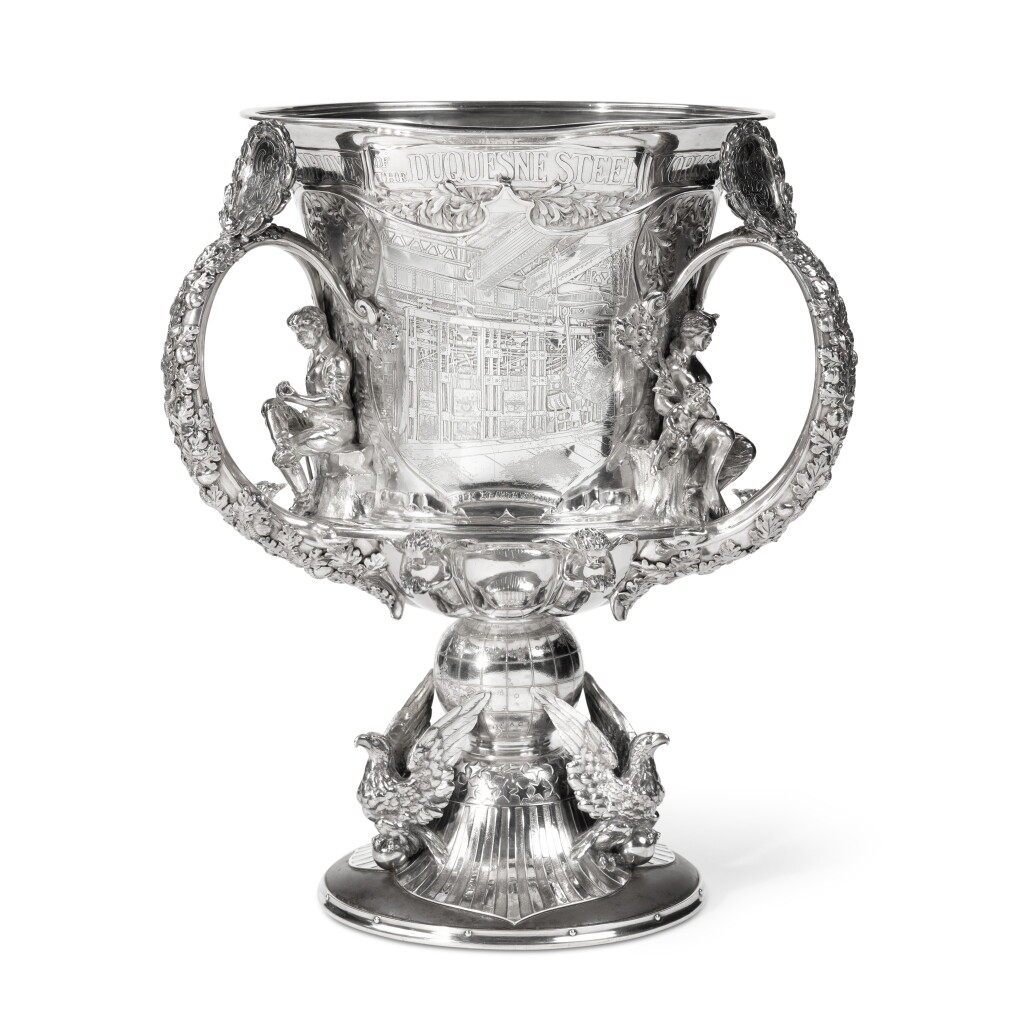
American Silver and Iron Three-Handled Presentation Cup, Tiffany & Co., New York, 1901
Auction Closed
January 23, 04:26 PM GMT
Estimate
30,000 - 50,000 USD
Lot Details
Description
American Silver and Steel Three-Handled Presentation Cup, Tiffany & Co., New York, 1901
of campana form, the body etched with three shields depicting scenes from steel mills entitled "BLAST FURNACES," "OPEN HEARTH FURNACE," AND "FORTY INCH MILL" below a ribbon etched with an inscription and surrounded by sprays of flowers and leaves, the forked c-scroll handles applied with oak sprays, each capped by a laurel wreath enclosing the monogram JES and each sheltering cast emblematic figures modeled in full relief as follows: a young miner seated on a rock holding a lump of coal and a pickaxe; a young mill worker seated on a riveted platform and holding a furnace rod; and a figure of Earth with a putto, seated on a tree trunk and holding a spray of foliage; the lower rim with six putti blowing on flames, the knop in the form of a labeled globe, the domed foot with three American shields and three eagles mounted over a iron base with a riveted silver rim, gilt interior, marked on base and numbered 14865/4450,
169 oz gross
5256 g
height 15 1/4 in.
38.7 cm
Sotheby's New York, June 27, 1990, lot 91
Property of the Masco Corporation, sold
Sotheby's New York, January 20, 1998, lot 43
This piece is listed in Tiffany's ledgers as "Love Cup - J.E. Schwab" and had a making charge of $875. An early photograph of the cup is reproduced in John Loring, Tiffany's 150 Years, p. 127. It is shown beside an old photo of the cup with dragon handles, full page illustration, presented to his brother Charles M. Schwab in 1901, now in the collection of the Southern Alleghenies Museum of Art.
The inscription reads "To Joseph E. Schwab From the Employees of the Duquesne Steel Works and Blast Furnaces June 1st 1901."
Joseph E. Schwab (1864-1922) entered Carnegie Steel in 1883. When his brother Charles became president in 1896, Joseph became General Supervisor of the Duquesne Works and subsequently the first president of the American Steel Foundries. The value of his holdings enabled him to become a major stock market speculator, which eventually led to his ruin when he unsuccessfully tried to corner the wheat market after the war. He had left his wife and children in 1907 to live with a vivacious Broadway actress and died of alcoholism in the Collingwood Hotel. See Robert Hessen, Steel Titan, Oxford University Press 1975.
This piece is listed in Tiffany's ledgers as "Love Cup - J.E. Schwab" and had a making charge of $875. An early photograph of the cup is reproduced in John Loring, Tiffany's 150 Years, p. 127. It is shown beside an old photo of the cup with dragon handles, presented to his brother Charles M. Schwab in 1901, now in the collection of the Southern Alleghenies Museum of Art.
You May Also Like


