
Property of the Descendants of Evans Carlson
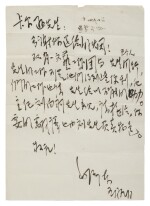
Mao Zedong, Calligraphic autograph letter to Evans Carlson, 9th May (1937) | 毛泽东同志致埃文斯•卡尔逊先生亲笔信 (1937年)5月9日
Lot Closed
September 22, 01:50 PM GMT
Estimate
100,000 - 150,000 USD
Lot Details
Description
Mao Zedong
Calligraphic autograph letter to Evans Carlson, 9th May (1937)
毛泽东同志致埃文斯•卡尔逊先生亲笔信 (1937年)5月9日
正面:
卡尔逊先生:
多谢你送给的烟!
现有一文藝工作团与先生五个人同行,先生的工作可從他们得到些便利,他们的工作也请先生给以万般的助力。主任刘白羽先生来见,请接洽,你要的翻译也由刘先生负责物色。
敬礼!
毛泽东
五月九日
背面:
Dugout
地下堡垒
Front:
Mr. Carlson,
Thank you for the cigarettes!
There will be an Art Troupe accompanying your team (of five). They will be at your service as I hope you will be to them. Director Liu Baiyu will meet with you. Please kindly be in touch. He is also in charge of finding the translator you requested.
Salute!
Mao Zedong
May 9th
Back:
Dugout
Height 10⅓ in., 26.3 cm; Width 7⅓ in., 18.6 cm
This highly important autograph letter by Mao Zedong (1893-1976), one of only three autographed letters ever to appear on the international market, pays testament to the extraordinary friendship and bond formed between the founder of the People’s Republic of China and Evans Carlson (1886-1947), who visited Yan’an as a military observer in 1937. In the letter, Mao thanks Evans for a gift of cigarettes, and tells him that an interpreter will be found by Liu Baiyu (1916-2005), the influential novelist and prominent member of the Communist Party of China (CCP).
Two other autographed letters signed by Mao Zedong have appeared at auction: the first, a letter written to the journalist Yang Yi (b. 1925) circa 1948, sold in our London rooms, 11th June 2019, lot 31, the second, a letter written to Major W.A. Dexheimer (b. 1901) in 1944, was offered in these rooms, 18th December 2019, lot 150. Other than these, the only auction records for Mao manuscript material, aside from signatures in albums, are manuscript notes on classical literature, written in 1975, sold in our London rooms, 11th July 2017, lot 28; a typed letter signed to the British socialist leader Clement Attlee (1883-1967), sold in our London rooms, 15th December 2015, lot 21; and a small group of documents and letters relating to negotiations with Zhang Xueliang (1901-2001), sold at Bonhams New York, 20th March 2013, lots 2, 3 and 5.
Two copies of 'The Little Red Book', signed by Mao Zedong and given to foreigners who attended a meeting at the Great Hall of the People, Beijing, 2nd July 1967, have appeared on the market. The first, given to Patrick Joseph Kelly (1929-2004), the New Zealander chairman of the Wellington District Communist Party, sold at Christie's London, 2nd December 2003, lot 89; and the second, given to Jan McLeod, a ballet student in China, sold at Christie's South Kensington, 16th November 2001, lot 65.
The current letter, however, is exceptional for being an autographed letter that exhibits Mao's remarkable skill at calligraphy and reveals an extraordinary friendship. Mao was celebrated as a master calligrapher in his lifetime, and his writing was displayed publicly on buildings across Beijing, including the Memorial to the Martyrs of the Revolution. He brought about new forms in Chinese calligraphy called "Mao-style" or Maoti, which has gained increasing popularity since his death. In manuscripts such as this letter, Mao followed the new fashion of writing from left to right, rather than from top to bottom, giving greater emphasis to the horizontal rather than vertical dimensions of characters. He most often used a hard-tipped brush in running script, as here, ideally suited to writing small characters quickly and clearly. He favored light and silken downward strokes, but when working with a thicker brush, he emphasized diagonal strokes more heavily. As Mao came closer to victory over the Kuomin-tang (KMT), his style became lighter and freer and began to juxtapose large characters with small ones. Written on plain paper rather than official stationery, this is the letter of a guerrilla leader not a head of state. It not only pays testament to the bond formed between Mao and Carlson, but is also an indicator of the friendship that would be formed between Carlson and Liu Baiyu.
As outlined by Jiang Wandi, 'A Camaraderie of 50 Years Ago', Beijing Review, 1988. Carlson's trip in 1937 in was a grueling 83-day, 1500-mile journey, commencing at Yan’an, in Shaanxi province, and covering Shanxi, Hebei, Shandong, and Henan provinces. During his trip to China, Carlson met with Mao Zedong, Liu Baiyu, Zhu De (1886-1976), Zhou Enlai (1898-1976), He Long (1896-1969), Deng Xiaoping (1904-1997), Peng Zhen (1902-1997), and other top Communist leaders. While traveling from Yan'an to Zhengzhou, in Henan Province, they also penetrated KMT-controlled areas several times and were met by local leaders.
The tour deepened Carlson’s understanding of the Chinese people, their leader, and their army. He was especially impressed by the bravery and flexible tactics of the Eighth Route Army against the much more powerful Japanese invaders. He attributed the army’s efficiency to its soldiers and officer’s political knowledge and high ethical standards. In his 1940 book, The Chinese Army: Its Organization and Military Efficiency, he wrote, "Troops (of the Eighth Route Army) are informed of the reasons why China is fighting Japan. They are taught to be truthful, honest, and selfless. They learn that the patient acceptance of hardship and privation is a form of self-sacrifice, and that self-sacrifice is the price of progress." Carlson later described the camaraderie he shared with the group in his 1940 book, Twin Stars of China: "Only those who have traveled together under severe conditions over long distances can understand the tender fellowship which such an association develops. Nationality and race mean nothing. It is the integrity of the human being that counts, and these sterling companions had proved their loyalty, their courage and their integrity on numberless occasions." As a Marine Corps officer, Carlson visited China four times between 1927 and 1940. On these trips, he met and talked with Chiang Kai-shek (1887-1975), his wife Soong Mei-ling (1898-2003), Defense Minister Chen Cheng (1898-1965), and other top civil and military leaders. He even attended Dr. Sun Yat-sen's (1866-1925) state funeral in June 1929. The report he wrote for his close friend former President Franklin D. Roosevelt (1882-1945) is said to be preserved at the Franklin D. Roosevelt Presidential Library and Museum in Hyde Park, New York.
Carlson was deeply attracted to Chinese culture, learned the language and developed a profound respect for the Chinese people. In 1940 he said, "For the past decade China has been marching forward---. This nation, with a civilization 5,000 years old, is destined to become a world power in her own right, and if she retains her independence she will become a democratic stronghold in Asia." When Carlson returned to the United States, he devoted himself to writing and speaking on China. However, his views on the political situation there differed so greatly from the U.S. government's that in 1939 he decided to resign from the Marine Corps. His activities as a civilian included lecturing on China as well as publishing his two books and many magazine articles in which he predicted the success of the Chinese Communists and pointed out the corruption of the KMT government. He also criticized continued American sales of scrap steel to Japan after learning in 1937 from Deng Xiaoping that many of the Japanese bombs falling on Chinese cities and villages contained scrap steel supplied by American businesses. He described this conversation in Twin Stars of China: "'Are you sure about that?' I asked. I knew that American sympathy was preponderantly on the side of China, who was the victim of aggression, and during the eight months I had been in the interior I had taken it for granted, when I had thought about the matter at all, that American people would refuse to sell war materials to an aggressor nation. What sublime ignorance!" "'Yes,' he assured me, 'the information came in a press dispatch from the United States at the end of the first year of the war.' I was distressed, and said that there must have been a mistake in the dispatch. I could not believe that American people would knowingly contribute to the carnage and suffering I had seen here during the past year." Carlson went on to warn that "The present struggle between China and Japan cannot be of merely academic interest to the people of the United States. It is a struggle the outcome of which will determine whether Eastern Asia will be ruled by a military autocracy, or whether the budding democracy of China will come into full bloom." "If Japan wins then America must look to her defenses, for the desire of the Japanese military-naval clique to crush America is no less intense than the desire of Germany to crush Great Britain. And yet America continues to provide Japan with the war materials with which to establish this hegemony!" Convinced that the Japanese would attack the Philippines, Guam, and Wake Island, Carlson rejoined the Marine Corps in 1941. When Pearl Harbor proved his prediction correct, he was asked to form a raider battalion to attack the Japanese lines from behind. In 1942, "Carlson's Raiders," modeled after the Chinese guerillas and using tactics and principles Carlson had learned about from the Eighth Route Army, carried out two of the first successful operations in Japanese-held territories in the Pacific theater of war.
The friendship between Carlson and Liu Baiyu was commemorated over 50 years later in 1988, when Liu was invited to the United States by the organization Evans F. Carlson Friends of the People’s Republic of China, along with Ouyang Shanzun (1914-2009), a playwright who served as an interpreter, and Wang Yang, a photographer, to pay his respects to their late American friend at Arlington National Cemetery. Liu Baiyu recalled being instructed by Mao to form an escort for an American officer who had come to Yan'an to tour northern China and observe the Chinese resistance.
As Liu Baiyu was leaving the U.S. in 1988, he commented, "Looking back on history, at the same time I was fighting snowstorms and bullets in North China, an American on the other side of the earth had foreseen our final victory." He then continues, "Half a century ago, when the Chinese people were struggling in an abyss of misery for their salvation and a better future, an American lent his enthusiasm and support. This will never be forgotten by the Chinese people. Now as we pluck the flowers and fruits of Sino-U.S. friendship, we should every now and then trace their origins back to those sowers of years ago."
The first meeting between Mao and Carlson is recorded in Carlson's autobiography, Twin Stars of China, New York, 1940, pp 166-171, where, amidst discussing how the CCP would ensure the defeat of Japan, Carlson makes a mental note to present Mao with a new pipe and some tobacco, a gift which the current letter documents:
"One evening Comrade Wang took me to see Mao Tse-tung [Mao Zedong], the famous leader of the Chinese Communists. Mao slept in the day time and worked at night.
A single candle lighted the room in which he worked, and when I entered I came face to face with a tall man whose leonine head dominated a well built body. Crowning the massive head was a mane of jet black hair, parted in the center and thrown back carelessly. Kindly eyes regarded me thoughtfully from a face that suggested the dreamer.
A gentle smile suffused his countenance as he gave me a warm firm handclasp. "Welcome," he said in a soft, low-pitched voice. "I have heard of your wanderings with our army, and I am glad to welcome you here."
The pale candle light, the severely plain appointments of the room, whose only furnishings were a k'ang, a wooden table and a few shelves of books, and perhaps above all the abstract air of Mao himself, gave the atmosphere a quality of other-worldliness. We seated ourselves at opposite sides of the table, and Mao called softly to the guard outside the window to bring tea and peanuts.
Here was the man whose mind had provided the foundation for China's modern liberal thought and whose flare for organization had established the bases on which rested the structure of the present Communist Party in China. With Chu Teh [Zhu De] he had led his people over the six thousand miles of hazardous terrain to the comparative security of these loess hills. And it was his extraordinary perception which was responsible for the pattern of resistance which was operating so effectively in Shansi and Hopei to neutralize Japan's superiority in modern weapons of war.
We talked late into the night, and our conversation covered the war, the political situation in Europe and America, the development of political thought down through the ages, the influence of religion on society and the ingredients of a successful world organization. He was an idealist, but there was a sound practical side to him as well. "
So long as our people have the will to endure hardship," he said, "and the will to continue resistance. China cannot be beaten. That will can only be built and sustained if the people have confidence in their leaders and are provided with hope for a better way of life. We try to provide these essentials by training leaders to live simply, administer justly and strive earnestly to aid the people to solve their problems. We believe that the better way of life lies in developing democracy and teaching the people how to govern themselves. Economic life, we feel, should be on a co-operative basis. Communism is not an immediate goal, for it can be attained only after decades of development. It must be preceded by a strong democracy, followed by a conditioning period of socialism."
He filled an old pipe with some of the long, stringy, yellow Chinese tobacco, and I made a mental note to send him a new pipe and some American tobacco.
"China," he continued, "is like a gallon jug which Japan is trying to fill with a half pint of liquid. When her troops move into one section, we move to another, and when they pursue us we move back again. Japan hasn't sufficient troops to occupy all of China, and so long as the people are determined to continue resistance she cannot control by political means."
He added that Japan has no main direction in her campaign in China. "A drive is made here, and another there. Instead of throwing a large force in at the beginning, re-enforcements have been brought in piece-meal. But her greatest mistake has been in the attitude of the army towards the Chinese people. By burning, raping and slaughtering they have enraged the populace and cemented the will to resist.”
"What are the plans," I asked, "of the Chinese Communist Party for the post-war period?”
Mao's eyes gazed off into space as though they sought to penetrate the haze that cloaked the future. Slowly he replied: “We hope to perpetuate the present entente with the Kuomin-tang, looking to the establishment of a real democracy with a two party government. We believe that the state should own the banks, mines and communications. The producers’ and consumers’ co-operatives should be developed, and we favor the encouragement of private enterprise. Finally, we feel that cordial relations should be established and maintained between China and those nations which are willing to meet us on a basis of equality."
There was certainly nothing very radical about these points. The banks, mines and communications were already owned by the Chinese government, in whole or in part. And there are many in the United States who feel that the cooperative idea is the answer to the growing friction between capital and labor. As for equality in international relations, this idea had gained ground rapidly in official American circles prior to the present conflict.
I recalled the controversy I had heard about the League of Nations hospital unit, and asked for his comment.
He smiled slowly. "We welcome such units, and we welcome those foreigners who come to help us. But the trouble with so many foreigners is that they soon want to dictate. They must remember that this is China, and that while their advice is eagerly received, we are the ones to decide if and how it will be used. With regard to the hospital, the foreign doctors wanted to give the patients in it better treatment than we can afford the patients in our own hospitals. It would mean that there would be inequality of treatment, and this is a question which must be studied carefully. The problem will be solved, but in our own way after due consideration."
Occasionally Mao would get up and pace the room as he talked, puffing on pipe or cigarette. His movements were graceful, even to the gesture of his hand when removing the pipe from his mouth.
Turning to the situation in Europe, I ventured the opinion that Britain would fight if Germany invaded Czecho-Slovakia.
“No,” replied Mao emphatically. "Britain will not fight for Czecho-Slovakia. If Germany should thrust to the southwest, Brain would fight, but she is not ready to fight for Czecho-Slovakia."
The following October, at Munich, Mao's prophecy was proved correct.
He returned to the struggle with Japan. "There are various types of besiegement," he ruminated. "Japan has us besieged at Wu T’ai [Wutaishan], where we are surrounded. And both Japan and China use the device of the salient, such as Sun Lien-chung [Sun Lianzhong] used at Taierchwang [Taierzhuang]. But we have another type. Take the Japanese garrison at T'aiyuanfu, for example." Here he pushed a tea cup over to represent this position, and around it he placed four other articles to represent Chinese positions. "Northeast of T'aiyuanfu is our force under Nieh Yong-sen, in Wu T’ai; to the northwest is Ho Lung; Lin Piao is to the southwest, and Chu Teh is to the southeast." He grinned mischievously. "The Japanese cannot move in Shansi without being pounced on by one of our patrols."
Then he added: "As Shansi is the strategic key to north China, so is the Wu T’ai region the key to Shansi. Japan cannot control the province so long as we possess Wu T'ai."
Whimsically, and with a twinkle in his eye, he concluded: "Another type of besiegement would be for the United States and Russia to join with China in besieging Japan. That would be an international besiegement."
It was early in the morning when I left Mao. I was to see him again before departing for the north, for he had promised to go into the matter of my proposed trip, but the vision of him which would remain with me was this picture of a humble, kindly, lonely genius, striving here in the darkness of the night to find a peaceful and an equitable way of life for his people'.