
Property from the Collection of Robert M. Edsel
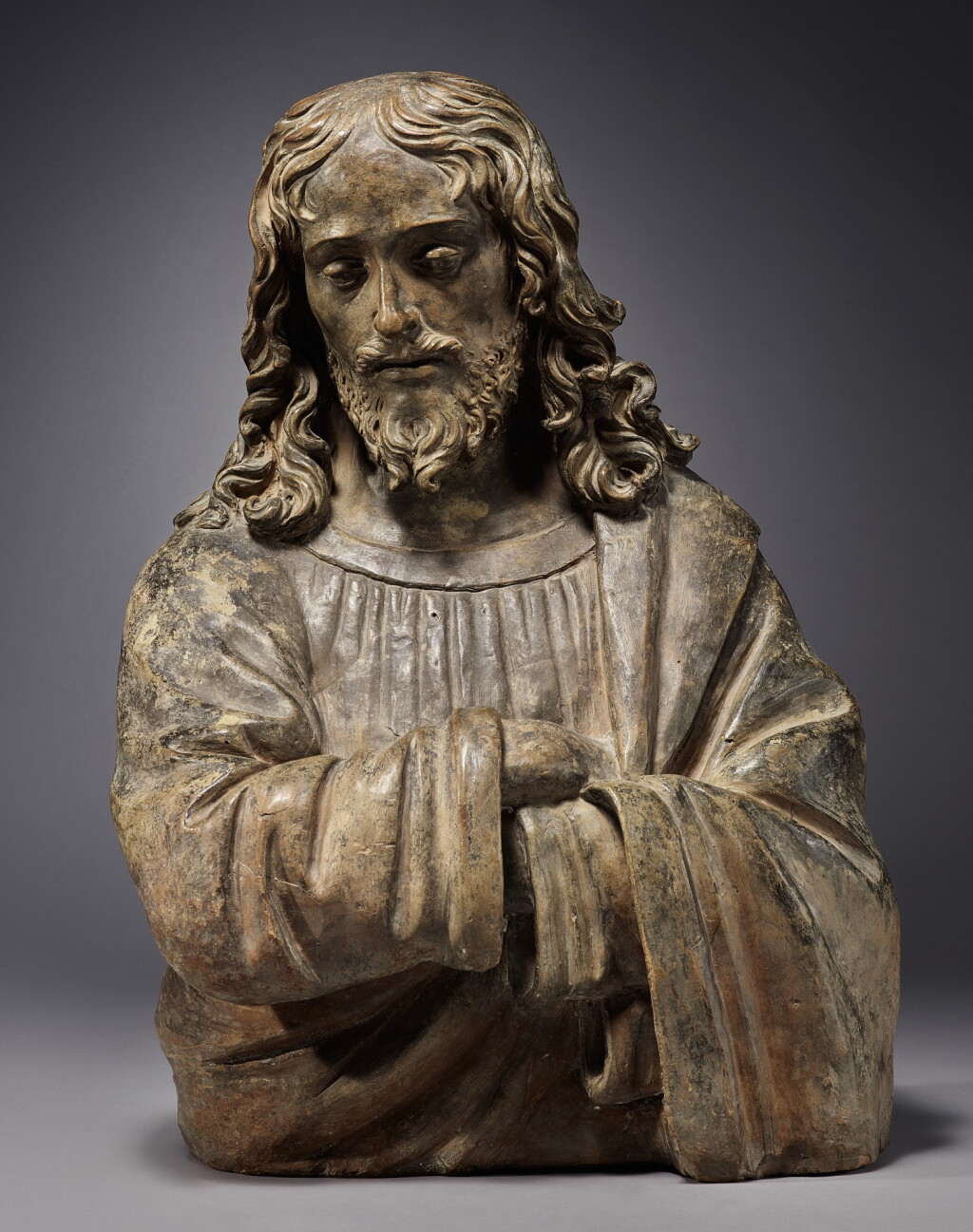
BACCIO DA MONTELUPO | SALVATOR MUNDI
Auction Closed
January 30, 06:45 PM GMT
Estimate
70,000 - 100,000 USD
Lot Details
Description
Property from the Collection of Robert M. Edsel
BACCIO DA MONTELUPO
(1469- CIRCA 1535)
FLORENCE, AFTER 1518
SALVATOR MUNDI
terracotta
height 23 ½ in.; 60 cm.
Jan Dirven, Antwerp, 1991
Previously ascribed to the circle of Verrocchio and to Agnolo di Polo, the rendering of the hair and general iconography of this powerful half-length figure of Salvator Mundi relates to the work of several Florentine masters including Benedetto da Maiano, Francesco di Simone Ferrucci and Verrocchio. However, this sculpture is strikingly innovative and demonstrates close affinity to the oeuvre of Baccio da Montelupo who worked with Bertoldo di Giovanni and collaborated with Michelangelo. The sculpture was probably modeled during Baccio da Montelupo's stay in Lucca immediately after 1518.
This type of bust of Christ seems to have originated in the Florentine workshop of Verrocchio, evidently derived from his monumental bronze statue of Christ from his Doubting Thomas group in Orsanmichele, 1466-1483, one of the most influential sculptures at that time. Moreover, the lasting influence of Verrocchio's marble figure of Christ made for the Forteguerri monument in Pistoia, completed in 1488, was immense and that piece apparently remained in Verrocchio's studio until 1493 when it was moved to Pistoia by Lorenzo di Credi who took over Verrocchio's workshop upon the master's death.
The present sculpture has been stylistically linked to a half-length terracotta of Christ in Pistoia by Verrocchio's assistant Agnolo di Polo, commissioned in 1498, now in the Museo Civico. However, that representation of Christ is shown with hands outstretched, his chin held higher and eyes gazing forward. The expression and position of the head in the Agnolo terracotta shows the more classical representation of Christ. Here, the Savior's arms are folded, nearly hidden by the heavy fabric of His large sleeves. His head is inclined with eyes gazing down in a contemplative, serene attitude. His lips are slightly parted, with the locks of hair curled and spiraled in long tresses which overlap and cascade down His shoulders. The animated rendering of the hair and beard is in stark contrast to the otherwise composed and authoritative expression and posture of the figure.
The wide, angular jaw, the heavily lidded eyes, with wrinkles at the edges, the long nose with very narrow bridge, high brow line and hair style correspond to other works attributed to Baccio, including the female figures from the Lamentation scene, Compianto, in the church of San Domenico in Bologna, circa 1495 (fig. 1). Clearly, Baccio embraced these disctinctive facial features throughout his career. Gatteschi (op. cit., p. 36) discusses the sculptures from the Lamentation as modeled with pain expressed in calm tones and almost silent resignation, as opposed to other important works created in Bologna during the same period which exhibit the extreme agony of the moment, such as Niccolò dell'Arca's Compianto in Chiesa di S. Maria della vita.
Vasari writes that Baccio studied classical sculpture in the "scuola" of Bertoldo di Giovanni, founded in the gardens of Lorenzo de' Medici in Florence. Among the other aspiring sculptors and painters studying there was Michelangelo, with whom Baccio later collaborated on projects such as the figures of the Piccolomini Altar in the Siena Cathedral and the carved frame of the master's Doni Tondi in the Uffizi. Perhaps the seminal moment in the sculptor's career was the commission in 1514, from a competition held by the Florentine silk merchants guild, to create a bronze for one of the niches in the facade of Orsanmichele. Baccio's St. John the Evangelist stood beside works by Donatello, Ghiberti and Nanni di Banco.
In around 1518, Baccio began work in Lucca, completing a marble Pietà for the church of Segromigno which was followed by a series of funeral monuments produced for prominent Tuscan families.
RELATED LITERATURE
Georgio Vasari, 'Baccio da Montelupo with Raffaello da Montelupo' .. in Lives of the Most Excellent Painters, Sculptors, and Architects, 1568
Riccardo Gatteschi, Baccio da Montelupo. Sculture e archietetto del Cinquecento, Florence 1993;
Till R. Verellen, 'Baccio da Montelupo' in Jane Turner, ed., The Dictionary of Art, vol. 22, New York, Grove, 1996, p. 15;
John Douglas Turner, The sculpture of Baccio da Montelupo, PhD Thesis, 1997
This lot is sold with a copy of a Thermoluminescence Analysis from Research Laboratory for Archeology, Oxford University, dated 2 July 1991, the result of which indicate the the terracotta was last fired between 340 and 520 years ago.