
Property from an Asian Private Collection
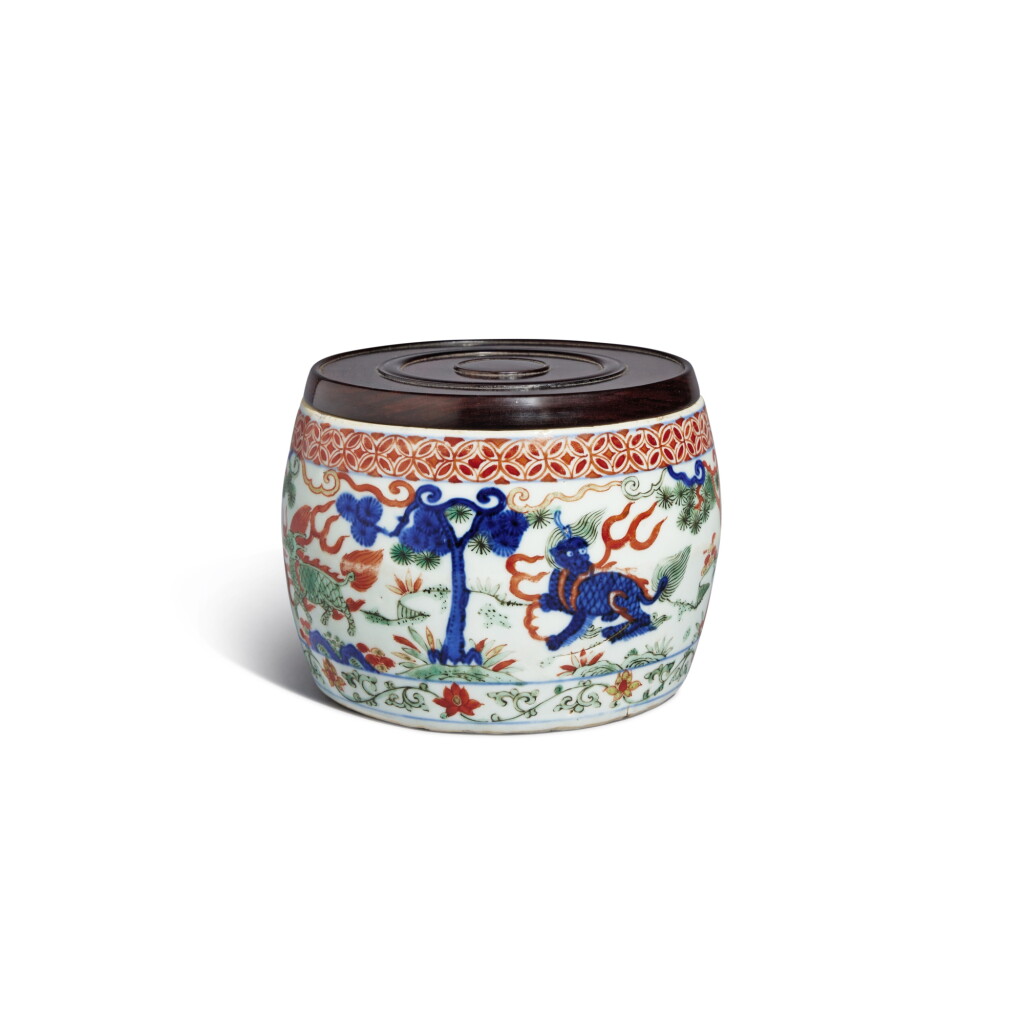
A rare wucai 'mythical beast' chess jar, Mark and period of Wanli | 明萬曆 五彩瑞獸紋罐 《大明萬曆年製》款
Auction Closed
September 20, 05:51 PM GMT
Estimate
80,000 - 120,000 USD
Lot Details
Description
A rare wucai 'mythical beast' chess jar
Mark and period of Wanli
明萬曆 五彩瑞獸紋罐 《大明萬曆年製》款
the base with a six-character mark in underglaze blue within a double circle, Japanese wood cover, stand, and box (5)
Diameter 5⅝ in., 14.5cm.
Japanese Private Collection.
日本私人收藏
This rare box is brilliantly enamelled in wucai with a vibrant scene of auspicious beasts including qilin. The usage of these drum-shaped boxes is still not fully understood. While some were probably made as cricket cages, related boxes, also extremely rare, may have been used by the Wanli emperor as containers for chess pieces (often known by its Japanese name go). In Japan, this form was later valued as mizusashi or water jars for the tea ceremony, a likely usage for the current box.
These drum-shaped boxes are often interpreted as chess jars. For example, Lu Minghua proposes this for a box in the Shanghai Museum, decorated with dragons chasing flaming pearls amongst clouds and above mountains and waves, illustrated in Lu Minghua, Shanghai Bowuguan cangpin yanjiu daxi / Studies of the Shanghai Museum Collections: A Series of Monographs. Mingdai guanyao ciqi [Ming imperial porcelain], Shanghai, 2007, pl. 3-104, and cites from Veritable Records of the Ming Shenzong Emperor a list of a variety of porcelains urgently required by the Wanli Emperor in the 12th year of his reign (1584), including chess pieces, chess jars, brush handles, and various other types of boxes. Another record in the Gazetter of Jiangxi Province lists many imperial porcelains made for the Wanli Emperor in the 11th year of his reign, including chess boards with dragon and clouds in wucai, as well as chess pieces with dragon design in underglaze blue, see Wang Guangyao, Ming dai gongting taoci shi [A history of ceramics for the Ming dynasty court], Beijing, 2010, p. 93. The polychrome dragon box in Shanghai may therefore represent a chess jar, having formed a set with the chess boards and chess pieces of similar decoration listed in the above record. The same may apply to a companion box missing the cover, illustrated in Suzanne Valenstein, The Herzman Collection of Chinese Ceramics, New York, 1992, pl. 85, now in the Metropolitan Museum of Art, New York.
Comparable examples to the current jar are rare. There are two slightly shorter boxes from the Iver Munthe Daae Collection: one, now in the Oslo Kunstindustrimuseet, illustrated in Johanne Huitfeldt, Porselenet fra Kina, Oslo, 1978, p. 80; the other sold in our Hong Kong rooms, 1st-2nd November 1994, lot 54, and illustrated in Sotheby's. Thirty Years in Hong Kong, Hong Kong, 2003, pl. 176. See also a jar complete with its cover sold in our Hong Kong rooms, 5th October 2016, lot 110, from the collection of a Paris connoisseur.
You May Also Like


