
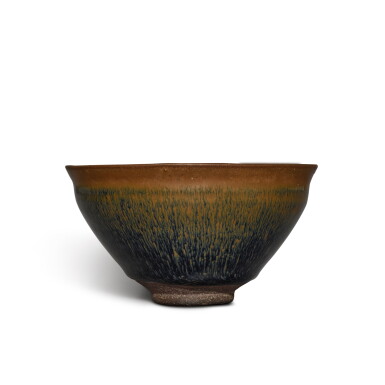
An exceptional 'Jian' 'Nogime Temmoku' tea bowl, Southern Song dynasty | 南宋 建窰禾目天目茶盞
Auction Closed
September 20, 05:51 PM GMT
Estimate
80,000 - 120,000 USD
Lot Details
Description
An exceptional 'Jian' 'Nogime Temmoku' tea bowl
Southern Song dynasty
南宋 建窰禾目天目茶盞
Japanese wood box (3)
Diameter 4⅝ in., 12 cm.
Japanese Private Collection, Kansai Region.
日本關西私人收藏
Bowls with this exquisite dappled black glaze with striking iridescent 'hare's fur' and 'oil spot' markings are among the most celebrated products of the Song dynasty kilns at Jian, in northern Fujian province. The desirability of these bowls coevolved with the tea-drinking tradition of the period.
At that time, Chan Buddhist priests prepared, imbibed, and served tea for its beneficial effects on the body and mind. The elaborate preparatory process – which involved scraping tea from a pressed cake, drying it, grinding it, putting it through a sieve, selecting the finest resulting powder, mixing it into a paste with warm water, and gradually adding additional water while simultaneously whisking it into a frothy beverage – played a central role in religious ceremonies. It also became fashionable in elite social circles. Sacred and secular enthusiasts alike sought to master the art of tea-making, with praise awarded to the person who achieved the richest froth.
The intrinsic qualities of Jian bowls made them particularly suited for tea preparation and enjoyment. In size and form, they were comfortable to hold. Their heavy potting had an insulating effect, keeping the tea inside hot while protecting the fingers from the heat. Their speckled black glazes, subtly imbued with the spectral colouration of refracted light, heightened the aesthetic experience of a well-formed white froth. Additionally, Jian bowls were made in the same province as the empire's prized teas, providing another link between the vessel and its contents.
Jian artisans experimented within this ceramic type with dazzling results. By manipulating body and glaze compositions, kiln temperatures, the cooling process, and allowing for the interventions of chance factors in the firing process, Jian ceramicists created wares that display the full potential of the iron oxide glaze. One of the most desirable and extremely rare effects is 'oil spot', in which tiny shimmering circles appear on the glaze. It is difficult to achieve because the craftsman must interrupt the firing between the moment when the spots form and the moment when they dissolve into streaks. Most 'oil spot' examples today are found in Japan, where they have long been prized and known as yuteki temmoku (oil-spot temmoku).
This type of glaze was so popular that it was copied by several northern kilns, which applied a dark brown slip to the unglazed part at the base to hide their light grey or brown stoneware body. These 'oil-spots' were formed when oxides of iron segregated themselves from the iron-saturated glaze during firing and crystallised on the surface during cooling (Robert D. Mowry, Hare's Fur, Tortoiseshell and Partridge Feathers. Chinese Brown- and Black-Glazed Ceramics, 400-1400, Cambridge, 1995, p. 222).
A similar Jian bowl with a metal rim mount, from the collection of the Tokyo Bunkacho, the Agency for Cultural Affairs, Tokyo, registered by the Japanese Government as an Important Cultural Property, was included in the Special Exhibition. Chinese Ceramics, Tokyo National Museum, Tokyo, 1994, cat. no. 198, and again in Song Ceramics, Tobu Museum of Art, Tokyo, 1999, cat. no. 76, together with a related oil-spot bowl with larger spots from the Museum of Oriental Ceramics, Osaka, which is designated as a National Treasure, cat. no. 74.
For other examples of similar quality sold at auction, see the 'Jian' 'temmoku' from the Aoyama studio, sold in our Hong Kong rooms, 8th April 2023, lot 3674, and another from the Plesch and Pilkington Collections, sold in our Hong Kong rooms, 6th April 2016, lot 12 and again 9th October 2020, lot 31.
You May Also Like


