After Lodovico Cardi, called 'Il Cigoli' (Villa Castelvecchio di Cigoli 1559 - 1613 Rome) Italian, second half of the 18th century
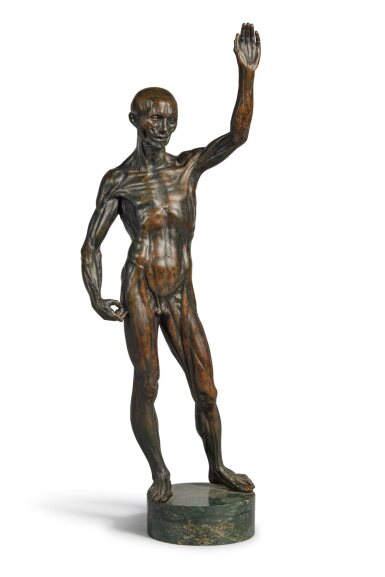
Écorché Figure of a Man
Lot Closed
October 19, 04:28 PM GMT
Estimate
40,000 - 60,000 USD
Lot Details
Description
After Lodovico Cardi, called 'Il Cigoli' (Villa Castelvecchio di Cigoli 1559 - 1613 Rome)
Italian, second half of the 18th Century
Écorché Figure of a Man
bronze
27 by 6 in.; 68.6 by 15.2cm.
Christie's New York, 6 June 2018, lot 72.
In the 17th century, the Italian art historian and biographer, Filippo Baldinucci, termed Cigoli’s masterpiece in sculpture, his wax écorché figure, 'La Bella Notomia', an anatomy of beauty, and described it as ‘The most beautiful and useful work to be seen in our Italy and in all of Europe’ (Bourla, op.cit., p. 320). The present bronze anatomical figure was cast after Cigoli's aforementioned wax now in the Museo Nazionale del Bargello, Florence. Committed to the study of anatomy throughout his career, Cigoli produced his 60 cm. high wax in around 1600 for the Accademia del Disegno to provide an educational tool for burgeoning artists. Subsequently cast in bronze, only four early (circa 1700 or earlier) bronze versions are known, comprising: one in the Victoria and Albert Museum, in the Bargello, in the Museum für Angewandte Kunst, Cologne and the present bronze, the only cast in private hands.
While the Bargello version is ascribed to Cigoli, it is likely that the popularity of the model, the continued interest in anatomical study and Cigoli’s reputation contributed to the production of casts in the 17th and 18th centuries. The London example (currently displayed with a date of circa 1580), the Cologne bronze (presumed to be a later 17th or 18th century cast) and a fine cast sold in these rooms on 30 January 2018 appear to be generally similar in facture to the present bronze.
Although major sculptors like Tetrode and Francavilla produced their own versions of écorchés, Cigoli’s was considerably more naturalistic. Consequently, versions of his statuette were used for centuries in art academies across Europe as a fundamental tool for an artist’s education. The sculptors Edmé Bouchardon, Jean-Antoine Houdon and Edgar Degas all produced écorché figures which depended on Cigoli's composition.
Cigoli went on to become a greatly admired draughtsman and leading painter in Florence. A pupil of Bernardo Buontalenti, Alessandro Allori and Santi di Tito, one of his first Medici commissions was an altarpiece of the Resurrection for a small chapel in the Palazzo Pitti, painted in 1590. He produced a number of important altarpieces for various Florentine churches in the late 1580s and 1590s culminating in the Martyrdom of Saint Stephen for the convent of Montedomini. In the early 17th century, he decorated the vaults of several rooms in the Palazzo Pitti, assisted by his pupil Cristofano Allori, and he also provided designs for pietra dura panels for the Cappella dei Principi in the church of San Lorenzo. Cigoli left Florence to work in Rome and produced paintings and frescoes for St. Peter’s’, Santa Maria Maggiore and for Cardinal Scipione Borghese.
RELATED LITERATURE:
L. Planiscig, Piccoli Bronzi Italiani del Rinascimento, Milan, 1930, pl. CCXXVI, fig. 383;
H. Gilhofer & H. Ranschburg, Lucerne, Sammlung Dr. Vicktor Bloch, Vienna, November 30, 1934, p. 35, lot 69;
Sechs Sammler stellen aus, exhibition catalogue, 7 April - 11 June 1961, Museum für Kunst und Gewerbe, Hamburg, cat. no. 49;
L. Price Amerson, Jr., The Problem of Écorché: Catalogue Raisonné of Models and Statuettes from the Sixteenth and later Periods, PhD Thesis, University of Pennsylvania, 1975.
The Rival of Nature: Renaissance painting in its context, exhibition catalogue, The National Gallery, London, 10 June to 28 September 1975;
J. P. Mouilleseaux, L'écorché,
exhibition catalogue, Musée des beaux-arts de Rouen, 15 January - 28 February 1977;
D. Petherbridge et. al.,C
orps à vif. Art et Anatomie,
exhibition catalogue, Musée d'art et d'histoire, Geneva, 18 June - 13 September 1998;
M. Kemp and M. Wallace, Spectacular bodies : the art and science of the human body from Leonardo to now, exhibition catalogue, Hayward Gallery, London, 2000;
A. von Hülsen-Esch und Hiltrud Westermann-Angerhausen, Zum Sterben schön: Alter, Totentanz und Sterbekunst von 1500 bis heute, 2006;
Burghley House, Heavenly Bodies: sculptural responses to the human form, exhibition catalogue, 1 April 2006 – 28 October 2006;
L. Bourla, 'Cigoli's ecorche and Giambologna's circle' in The Sculpture Journal, 2015, pp. 317-332.
You May Also Like