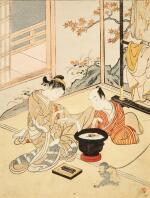

Suzuki Harunobu (1725-1770) | A courtesan and her client beside a brazier | Edo period, 18th century
Lot Closed
September 11, 09:01 AM GMT
Estimate
6,000 - 8,000 GBP
Lot Details
Description
Suzuki Harunobu (1725-1770)
A courtesan and her client beside a brazier
Edo period, 18th century
woodblock print, unsigned, circa 1768-69; with collectors' seals of Hayashi Tadamasa and Henri Vever at bottom right corner, framed
Vertical chuban:
27.6 x 20.8 cm., 10⅞ x 8¼ in. (the print)
47 x 39 cm., 18½ x 15⅜ in. (the frame)
Hayashi Tadamasa (1853-1906)
Henri Vever (1854-1942)
Sotheby's, London, Highly Important Japanese Prints, Illustrated Books, Drawings and Paintings from the Henri Vever Collection, Part III, 24 March 1977, Lot 34
Pari Beberu korekushon, ukiyo-e meisaku 300 senten (300 Masterpieces of Ukiyo-e from the Vever Collection), exhibited at the following venues:
Keio Department Store, Tokyo, 4th - 15th January 1975
Hanshin Department Store, Osaka, 6th - 18th February 1975
Sogo Department Store, Hiroshima, 21st - 26th April 1975
Pari Beberu korekushon ukiyo-e meisaku 300 senten (300 Masterpieces of Ukiyo-e Prints from the Vever Collection), exh. cat., (Tokyo, 1975), no. 60.
On a cold evening in late autumn or early winter, a young courtesan dressed in a kimono with a design of snow-covered plum branches kneels beside a brazier whilst writing on a poem slip (tanzaku). Her client observes whilst reclining under winter robes. A tethered pet monkey sits near the brazier eating a fruit and further winter robes hang on a kimono stand (iko) behind them.
Japanese woodblock prints overall found a dynamic reception in the West during the latter half of the nineteenth century. The print bears the collector’s seal of Henri Vever (1854-1952), one of the most prolific collectors of Japanese prints. Other early collectors included artists, such as Felix Bracquemond (1833-1914), Edouard Manet (1832–1883), Claude Monet (1840–1926) and Edgar Degas (1834–1917), as well as art critics like Philippe Burty (1830–1890). Many of the great early collections of ukiyo-e were assembled with the assistance of Hayashi Tadamasa (1853-1906), an art dealer from Nagasaki who established himself in Paris in 1878. In the United States, one of the foremost collectors of woodblock prints was the architect Frank Lloyd Wright (1867-1959), who sold a legacy of his collection to the Metropolitan Museum of Art (The MET) between 1918-22.
Another impression of the same print is in the collection of the Museum of Fine Arts, Boston, accession number 11.19713, go to:
You May Also Like


