
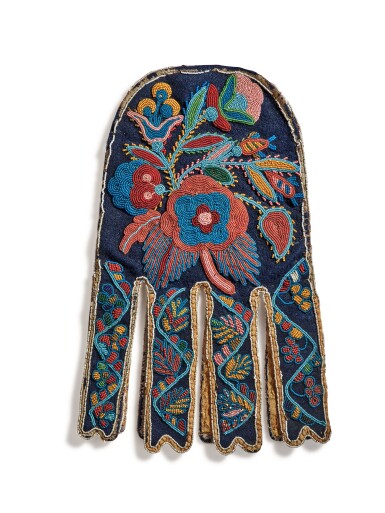
Athabascan Octopus Bag
Lot Closed
April 8, 05:03 PM GMT
Estimate
5,000 - 7,000 USD
Lot Details
Description
Athabascan Octopus Bag
Length: 12 ⅝ in (32 cm)
Abraham Rosman and Paula Rubel, New York, acquired from the above on January 25, 1997
The historian Kate C. Duncan traces the octopus bag's origins back to eighteenth-century "double-tabbled bags" from the upper Great Lakes region. During the mid-nineteenth century these highly distinctive bags enjoyed immense popularity amongst the Cree and Cree-Métis, who carried them across the continent, exciting admiration and occasionally imitation as they went. Eventually, the bags reached the hands of the inland and coastal Tlingit, who named them octopus or devil fish bags, in reference to the four pairs of hanging tabs. (Duncan, “So Many Bags, so Little Known”, Arctic Anthropology, Vol. 28, No. 1, 1991, p. 57).
Bags such as the present lot from the northern interior usually feature “European-inspired floral designs rendered in overlay-style bead embroidery […]”, a form of decoration which gradually spread its way across the northern part of the continent, ultimately reaching the coast in the late nineteenth century (Vincent, Brydon, and Coe, eds, Art of the North American Indians: The Thaw Collection, Cooperstown, 2000, p. 303). Here the fabric of the bag itself is composed of one of the staple cloths of the fur trade, blue stroud, attached to a backing of calico. The rich yet sober blue of the wool provides a very effective ground for the wonderfully lively floral motifs, delicately executed in tiny seed beads.
You May Also Like

![[Huntley & Palmer Biscuits] A George V trompe-l'oeil printed-tin-plate biscuit tin in the form of a book by Huntley, Boore & Stevens, circa 1924-1930](https://sothebys-md.brightspotcdn.com/dims4/default/b9fda52/2147483647/strip/true/crop/2938x2938+0+0/resize/150x150!/quality/90/?url=http%3A%2F%2Fsothebys-brightspot.s3.amazonaws.com%2Fmedia-desk%2Faa%2F8b%2Fb132a12142b486a7f2d28dad0e73%2Fl26402-dldrq-t3-01.jpg)

![[Robert Burns] A Scottish polished burr sycamore snuffbox, probably Mauchline, Ayrshire, 19th century](https://sothebys-md.brightspotcdn.com/dims4/default/8c2252a/2147483647/strip/true/crop/6732x6732+0+0/resize/150x150!/quality/90/?url=http%3A%2F%2Fsothebys-brightspot.s3.amazonaws.com%2Fmedia-desk%2F6d%2Feb%2Fabce5d0d4a0a9ec8ff490de5cf58%2Fl26402-dldpq-t3-04.jpg)


