
Property from a European private collection | Provenant d'une collection particulière européenne
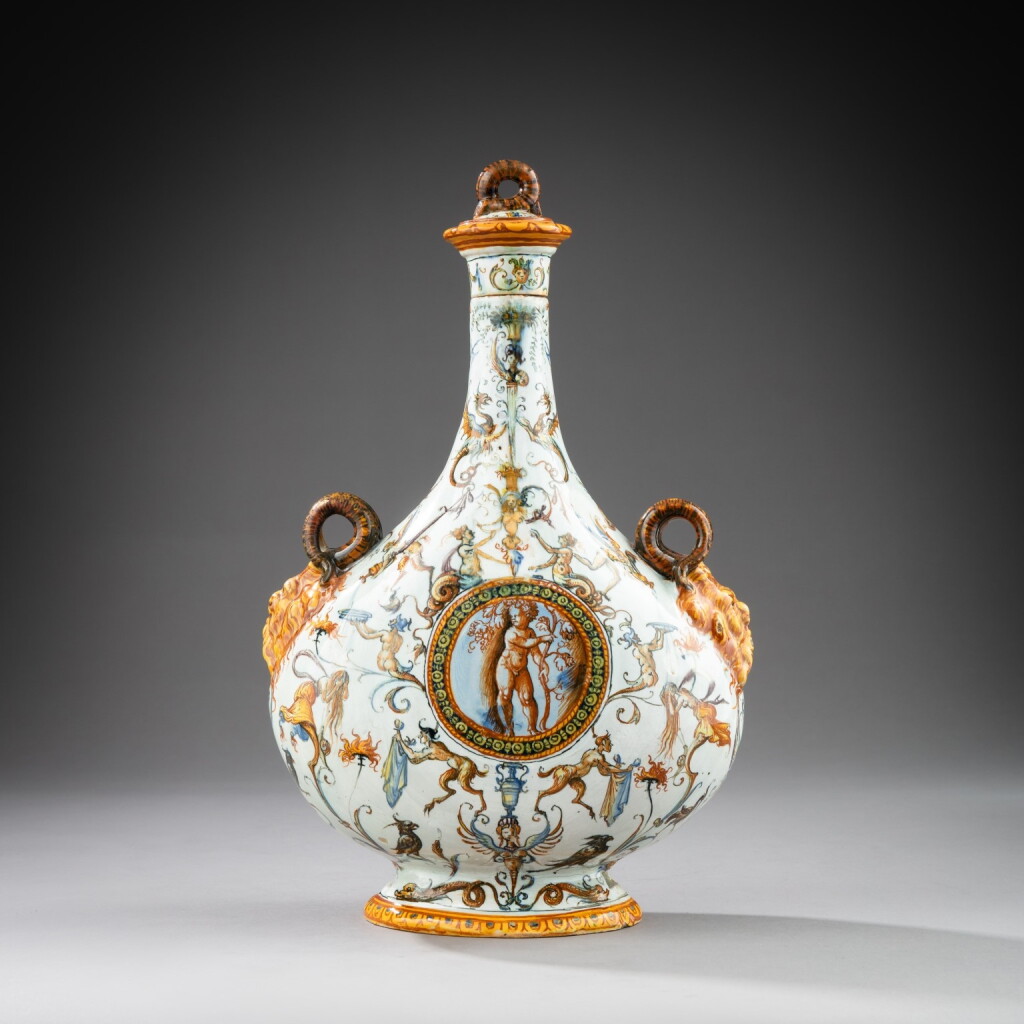
Fontana or Patanazzi workshop | Atelier des Fontana ou atelier des Patanazzi
Pilgrim's flask with grotesques | Gourde de pèlerin à décor de grotesques
Auction Closed
November 22, 02:50 PM GMT
Estimate
10,000 - 15,000 EUR
Lot Details
Description
Urbino, Fontana or Patanazzi workshop, circa 1570-1590
Pilgrim's flask with grotesques
tin-glazed earthenware (maiolica)
decorated with white-ground grotesques, the number of the Fountaine sale (n° 70) partially painted in red and effaced under the foot
36cm. high, 14⅛in.
____________________________________________
Urbino, Atelier des Fontana ou atelier des Patanazzi, vers 1570-1590
Gourde de pèlerin à décor de grotesques "a raffaellesche"
faïence émaillée (majolique)
à décor de grotesques sur fond blanc
le numéro d'inventaire d'Andrew Fountaine 70 écrit à l'encre rouge partiellement visible sous la base
Haut. 36 cm ; 14 ⅛ in.
Sir Andrew Fountaine (1676 - 1753), Narford Hall, Norfolk;
Thence by descent until sold, London, Christie's, June 16-19 1884, Catalogue of the celebrated Fountaine Collection of Majolica, Henri II Ware, Palissy Ware, Nevers Ware, Limoges Enamels, no. 70;
Lowengard Collection, Paris.
____________________________________________
Collection Sir Andrew Fountaine (1676 - 1753), Narford Hall, Norfolk ;
Dans sa descendance jusqu'en 1884 ;
Sa vente, Christie's Londres, 16-19 juin 1884, Catalogue of the celebrated Fountaine Collection of Majolica, Henri II Ware, Palissy ware, Nevers Ware, Limoges Enamels, lot 70 ;
Collection Lowengard, Paris.
J. Dubouloz, "La Vente Fountaine", in Le Courrier de l’Art, 20 juin 1884, p. 297, n° 70 ;
A. Moore, ‘The Fountaine Collection of maiolica’, The Burlington Magazine, 130, p. 435‑47, mentionné p. 444.
Decorations with grotesques on a painted white ground a raffaellesche, appeared on maiolica in Urbino about 1560 and was often more or less copied from the Petites Grotesques published by the French architect and designer Jacques Androuet du Cerceau which were published in two editions of 1550 and 1562.
The shape, size, and decoration on this flask are comparable to two flasks in the Museo Nazionale del Bargello which are already listed in a Medici Grand-Ducal inventory of 1588 and may have been acquired from the Fontana family workshops some years earlier.1 However, the meticulous and imaginative grotesques were probably painted in the Fontana workshop in Urbino, or possibly soon after the workshop had passed, by 1580, under the management of the Patanazzi family.
A PRESTIGIOUS PROVENANCE: SIR ANDREW FOUNTAINE (1676-1753)
The legendary Fountaine collection was formed by the Antiquarian, amateur architect, son and heir to Andrew Fountaine M.P. and one of the most distinguished art collectors in England during the first half of the 18th century, Sir Andrew Fountaine (1676-1753), was educated at Eton College and then at Christ Church College, Oxford. It was through William Cavendish, second Duke of Devonshire (1672-1729) and friend of his father, that the young Andrew was introduced to court and knighted in 1699. When Fountaine accompanied Lord Macclesfield to various European courts in 1701, Fountaine quickly became a favorite and in 1702, he toured Italy and established a close relationship with the Grand Duke of Tuscany, Cosimo III de Medici (1642-1723). During his second Grand Tour in Florence and Rome from 1714-1717, Fountaine enriched his collection of majolica, enamels, paintings, and sculptures.
The collection was added to by two later family members, Andrew Fountaine III (1770-1835) and Andrew Fountaine IV (1808-1873). In 1835, when Andrew Fountaine IV inherited Narford Hall, following the death of his father, he compiled an inventory in of the art collections. The present flask is described in the "octagon closet", either p. 39 "bottles some finely shaped: 1. A pair painted with grotesques. Shelf 1." or p. 40 "7. Painted with grotesques. S. II".2 Fountaine continued the tradition of collecting Renaissance maiolica and the collection remained intact until it was sold by the family and dispersed in 1884.
1 M. Marini, Maiolica and Ceramics in the Museo Nazionale del Bargello, Turin 2024, nos 282, 283.
2 A. Moore, 'The Fountaine Collection of maiolica', The Burlington Magazine, vol. CXXX no. 1023, June 1988, pp.435-447
We are grateful to Professor Timothy Wilson and Mrs. Greta Kaucher for their invaluable contributions to the research on this entry.
____________________________________________
Les ornements grotesques sur fond blanc peint (raffaellesche) sont apparus sur la maïolique à Urbino vers 1560. Ils étaient généralement plus ou moins inspirés des Petites Grotesques publiées par l'architecte et dessinateur français Jacques Androuet du Cerceau, dont les deux éditions datent de 1550 et de 1562.
La forme, la taille et le décor de ce flacon sont comparables à deux flacons conservés au Museo Nazionale del Bargello, qui figurent dans un inventaire grand-ducal des Médicis de 1588 et qui pourraient avoir été acquis auprès des ateliers de la famille Fontana quelques années auparavant1. Ces grotesques minutieux et imaginatifs ont probablement été peints dans l'atelier Fontana d'Urbino, ou peut-être peu après que l'atelier soit passé sous la direction de la famille Patanazzi, vers 1580.
UNE PROVENANCE PRESTIGIEUSE : SIR ANDREW FOUNTAINE (1676-1753)
La légendaire collection Fountaine fut constituée par l'antiquaire, architecte amateur, fils et héritier d'Andrew Fountaine M.P., l'un des plus éminents collectionneurs d'art en Angleterre durant la première moitié du XVIIIe siècle, Sir Andrew Fountaine (1676-1753), qui fit ses études à Eton College puis à Christ Church College, Oxford. C'est par l'intermédiaire de William Cavendish, deuxième duc du Devonshire (1672-1729) et ami de son père, que le jeune Andrew est introduit à la cour et anobli en 1699. Lorsque Fountaine accompagne Lord Macclesfield dans diverses cours européennes en 1701, il devient rapidement un favori et, en 1702, lors d'une visite en Italie il établit une relation étroite avec le grand-duc de Toscane, Cosimo III de Medici (1642-1723). Lors de son second Grand Tour à Florence et à Rome, de 1714 à 1717, Fountaine enrichit sa collection de majoliques, d'émaux, de peintures et de sculptures.
La collection fut complétée par deux membres ultérieurs de la famille, Andrew Fountaine III (1770-1835) et Andrew Fountaine IV (1808-1873). En 1835, lorsqu'Andrew Fountaine IV hérita de Narford Hall suite au décès de son père, il dressa un inventaire des collections. Le présent flacon est décrit dans le « placard octogonal », soit p. 39 « bottles some finely shaped : 1. A pair painted with grotesques. Etagère 1 » ou p. 40 « 7. peintes de grotesques. S. II »2. Fountaine enchirissa la collection de maïoliques de la Renaissance et cette ensemble resta intacte jusqu'à ce qu'elle soit vendue par la famille et dispersée en 1884.
1 M. Marini, Maiolica and Ceramics in the Museo Nazionale del Bargello, Turin 2024, n° 282, 283.
2 A. Moore, « The Fountaine Collection of maiolica », The Burlington Magazine, vol. CXXX n° 1023, juin 1988, p. 435-447.
Nous remercions le professeur Timothy Wilson et Mme Greta Kaucher pour leur précieuse contribution aux recherches concernant cette œuvre.