
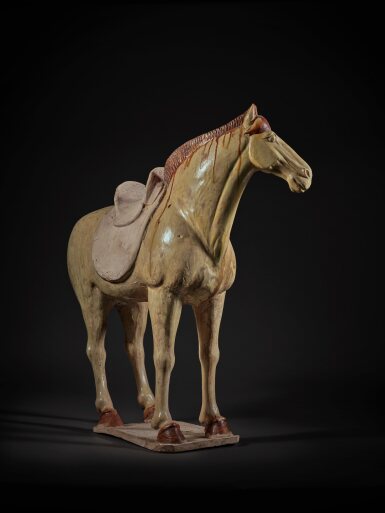
A straw and chestnut-glazed pottery figure of a horse, Tang dynasty
No reserve
Auction Closed
September 18, 08:03 PM GMT
Estimate
40,000 - 60,000 USD
Lot Details
Description
Width 25¼ in., 64.3 cm
Colorado Private Collection.
Sotheby's New York, 26th March 1971, lot 134 (cover lot).
Collection of Marcus Giller.
Alan Hartman, New York.
China House of Arts, New York, by 1989.
China House of Arts, New York, 1989.
Reflections of Ancient China, China Gallery, New York, 2005.
Horses have long been a symbol of status and wealth. The representation of a horse of large size and desirable coloration such as the present example reflects the high rank and importance of the owner and his or her family. Furthermore, the artisans who modeled and decorated the piece evince their skill through deft, naturalistic modeling. The horse's body is generously covered in a lustrous straw-colored glaze while the carefully depicted mane is decorated in a warm chestnut-color, harmoniously echoing the four hooves which are also covered in the same brown glaze.
In the Tang dynasty, the importance of horses rose to new heights and their ownership was strictly regulated. Strong, powerful horses from Central Asia were believed to be mythical steeds that were dragons in disguise. In Lidai minghua ji (Record of famous painters of all periods), Zhang Yanyuan noted that Emperor Xuanzong 'loved large horses and ordered the famed artist Han Gan to paint the most noble of his more than 400,000 steeds', six of these, all bred from the famed Ferghana stock in Central Asia are described by their respective colors: red, purple, scarlet, yellow, 'clove', and 'peach-flower' colored, respectively. The most famous painting, Night-shining White (Zhaoyebai), is now in the Metropolitan Museum of Art, New York. Indeed, Han Gan's distinctive style which captures the animals in spirited movement, emphasizing their rounded and muscular forms while retaining an easy naturalism, can also be observed in the present piece, in which the animal is depicted as powerful, agile and almost celestial.
For an example of a closely-related horse, similarly-molded and decorated but of slightly larger size, see one excavated in Luoyang, Henan province, in 1928, illustrated in Tang sancai / Tri-color Pottery of the T'ang Dynasty, National Museum of History, Taipei, 1977, pl. 37. See a pair of pottery horses, covered in an amber or straw glaze respectively and without a saddle, from the collection of Jay I. Kislak, sold in these rooms, 23rd March 2022, lot 313.
You May Also Like


