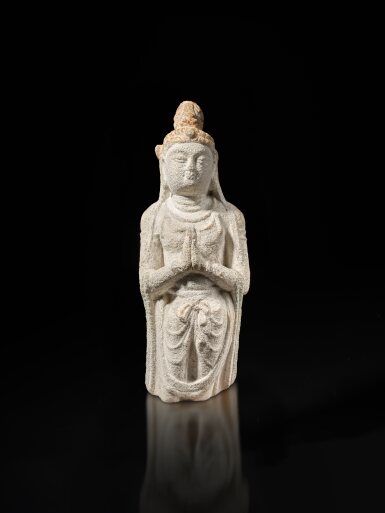
A finely carved sandstone figure of a Bodhisattva, Tang dynasty
Auction Closed
September 18, 08:03 PM GMT
Estimate
100,000 - 200,000 USD
Lot Details
Description
wood stand (2)
Height 12⅞ in., 33 cm
Collection of Dickson Reck (1904-1955), acquired circa 1940.
Christie's New York, 19th September 2006, lot 137.
This finely carved image of a bodhisattva, so gracefully carved from attractive granulated sandstone of whitish tone, yet retaining unusually strong traces of its original pigments, encapsulates the artistic spirit of the high period of the Tang dynasty, when China's sculptural tradition reached its most mature phase. The modeling of the male bodhisattva is articulated with vivid realism, the dignified poise endowed with the utmost spirituality. It is a figure of unusually small size, depicted standing with palms held together in anjali mudra, long flowing robes and an elaborate top knot tying the hair, retaining much of its original red pigments. In contrast to the more sinicised treatment of the human form in the Northern Qi and Sui dynasties, sculptures of the high Tang period show a deep level of influence from the artistic style of the Indian Gupta Empire, itself embued with resonances of the Hellenistic tradition. This is visible not only in the form of the figure itself, but also in the graceful folds of the robes. However, where Gandharan and other earlier prototypes are sterner and more distinct in their seated posture, sculptures of the high Tang period are characterized by gentle S-curves on the body and hips slightly tilted to one side, which imbue the figures with dynamic movement and deep sensuality. These characteristic touches of the high Tang are heightened by the exquisite details the sculptors were able to bring to life from the versatility of the stone: the skilfully defined torso; the graceful curve of the body and the opulent jewelry.
The bodhisattva exhibits close stylistic similarities with other recorded examples from China's cave temples, particularly those of Tianlongshan, such as the sandstone bodhisattva donated by Eduard von der Heydt to the Rietberg Museum, Zurich, illustrated in Museum Rietberg, Zurich, 2002, pp 62-63. Another sandstone figure of a standing bodhisattva also shown with hands held in anjali mudra is illustrated by Rene-Yvon d'Argencé and Diana Turner (ed.) in Chinese, Korean and Japanese Sculpture in the Avery Brundage Collection, San Francisco, 1974, p. 216, no. 107. The form and contours of the torso also closely relates to two other Tang dynasty sandstone figures sold at auction, one from the Patiño family collection, acquired by Eskenazi in these rooms, 3rd December 1986, lot 280, and now in the collection of the Kimbell Art Museum, Fort Worth, illustrated in Giuseppe Eskenazi in collaboration with Hajni Elias, A Dealer's Hand. The Chinese Art World Through the Eyes of Giuseppe Eskenazi, London, 2012; Chinese version, Shanghai, 2015, reprint, 2017, pl. 119; and another from the collection of Stevenson Burke (1879-1962), sold in these rooms, 8th May 1980, lot 77 and more recently in our Hong Kong rooms, 2nd April 2018, lot 3023.
Dickson Reck, born in Rockford, Illinois in 1904, had a distinguished career as a professor of business administration at the University of California, and also worked in government. In the Second World War, he served with the Department of State as an appointed adviser to the Ministry of Economic Affairs of the Republic of China in Chongqing, where he developed his love of China and began to form his collection.
You May Also Like