
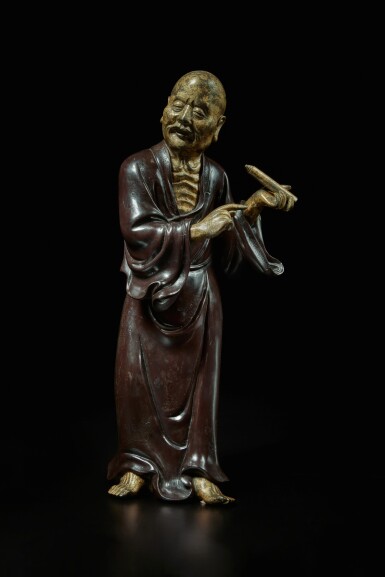
A large parcel-gilt bronze figure of a Luohan, Qing dynasty, Qianlong period
Auction Closed
September 18, 08:03 PM GMT
Estimate
60,000 - 80,000 USD
Lot Details
Description
cast to the back with the inscription Jingkang ernian zhongqiu wangri wujin zhizao Ligang zhencang (the full moon day of mid-autumn, second year of the Jingkang period; made of metal; in the treasure collection of Li Gang), wood stand (2)
Height 16⅝ in., 42.1 cm
Collection of Louis Depagne (1926-2006).
A & J Speelman Ltd, London, 1983.
His hands delicately poised, his face quiet in contemplation and feet raised as if about to take a step, this rare figure is an exceptional example of bronze sculpture produced in the Qianlong period. Adopting the serenity and smoothness of bronze sculptures from the Ming dynasty – particularly those based on ivory carvings and porcelain figures produced at the Dehua kilns in Fujian – Qing sculptors continued to develop the craft with a preference for more complex surface detailing and the grander aesthetics of Buddhist iconography.
Richly incised with cloud-scrolls and a lotus band to the edge, the naturalistic rendering of the present robe is reminiscent of silver-inlaid works bearing a 'Shisou' or 'Xinyu' mark. Although legends of a specific monk named Shisou from the late Ming period remain unsubstantiated and the identity of the artisan or workshop responsible for these masterpieces is yet unclear, the impact of these pieces is clear. Compare a stylistically-related kneeling figure of Guanyin bearing a 'Shisou' mark with similar lotus-decorated lapels and stylized clouds across her flowing robes, sold in our Hong Kong rooms, 8th October 2019, lot 3632.
The inscription on the rear of the figure reads, 'the full moon day (i.e. the 15th) of mid-autumn (the 8th lunar month), second year of the Jingkang period (1127 CE); made of metal; in the treasure collection of Li Gang.' This apocryphal inscription makes reference to one of the most tumultuous times in China's history, when the Northern Song dynasty fell to the Jurchen invasion after the Jingkang Incident of 1126. In this tumult, Li Gang (1083-1140) – then Grand Chancellor of the crumbling empire – emerged as a staunch proponent of military resistance. Even six hundred years later, Li Gang's patriotism, bravery and stirring poems must have been remarkable symbols of virtuous leadership; an archetype of true public service.
Very few figures of this style, size and quality have ever appeared on the market. Compare two gilt-bronze figures depicting the Daoist figure Liu Hai holding his three-legged toad and a coin: one, with a stand and inscription dating it to 1737, sold in our Hong Kong rooms, 8th October 2010, lot 2793; the other, with a closely related Jingkang dedication to Li Gang, sold in our London rooms, 23rd April 1963, lot 93.
You May Also Like


