Property from the C.C. Wang Family Collection
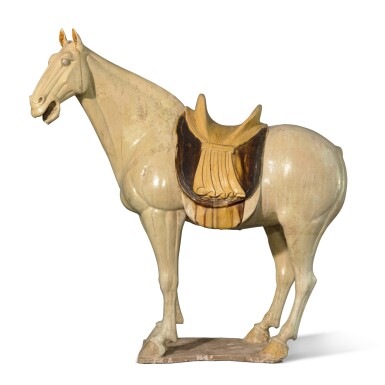
A magnificent and massive sancai-glazed pottery figure of a horse, Tang dynasty
Auction Closed
September 18, 08:03 PM GMT
Estimate
100,000 - 150,000 USD
Lot Details
Description
Height 30⅛ in., 76.5 cm
Eskenazi Ltd, London, 1999.
Ancient Chinese Bronzes and Ceramics, Eskenazi Ltd, New York, 1999, cat. no. 17.
With a strong, muscular build and sturdy legs, this imposing figure of a horse is among the highest quality of ceramic sculptures made during the Tang dynasty and tells of the masterful hand of a long-forgotten artisan, who so skillfully rendered the animal's vigor and poise. The figure is covered with a layer of creamy glaze with its saddle rendered in hues of yellow and brown. This understated yet vivid coloration is a variation of the famous sancai (literally 'three colors') palette of lead-fluxed glazes. Around the early Tang dynasty, sancai pottery appears to have been used primarily for burial wares, particularly among society's elite and, millenia later, still retains its rich color.
By the Tang dynasty (618-907) horses had gained a reputation not just as an important means of transportation and warfare, but as a symbol of wealth and leisure. Imported along the Silk Road in exchange for precious textiles or gold, these horses were housed in expansive stables and parks near the Tang capital of Chang'an (modern Xi'an in Shaanxi province). Especially admired since their discovery by Chinese officials in the Han dynasty were the so-called 'Heavenly Horses' of the Ferghana Valley in Central Asia, often depicted – like the present lot – with rigid fore-legs and stocky chests.
Recreating possessions in pottery and other materials as funerary offerings (known as mingqi), Tang elites sought to bring their wealth and status into the next world. Unsurprisingly, models of these prized animals soon became an important part of these offerings, particularly among the highest echelons of society and the imperial family. Although some horses from this period feature hair and reins sculpted in clay, the present lot is of the more valuable type which sought to merge this world and the next, with its tail, mane, harness and trappings originally crafted from perishable materials, such as hair and leather, that have long since fallen away.
Figures of horses from the Tang dynasty of such a considerable size are rare. Compare a related horse, decorated with a creamy glaze and featuring a similarly sculpted face, preserved in the British Museum (accession no. 1936,1012.227), illustrated in Jessica Rawson, The British Museum Book of Chinese Art, London, 1992, pl. 158, p. 217; another sold in our London rooms, 31st October 1974, lot 7; and another, slightly smaller, sold in these rooms, 19th March 2013, lot 81.
For horses of a similar large size, but with sculpted tails and manes, see one excavated in 1928 in Luoyang, Henan province, preserved in the National Museum of History, Taipei (accession no. h0000030), illustrated in Tang sancai tezhan tulu / The Special Exhibition of Tang Tri-Colour, National Museum of History, Taipei, 1995, cat. no. 31; and a pair, sold twice in these rooms, 27th March 2003, lot 36, and again 18th September 2013, lot 45.
Compare also several related examples but of a smaller size: one covered in light yellow glaze, excavated in 1928 at Luoyang, Henan province, preserved in the National Museum of History, Taipei (accession no. h0000020), illustrated in op. cit., National Museum of History, Taipei, 1995, cat. no. 30; another illustrated in Treasures of Asian Art: The Asia Society's Mr. and Mrs. John D. Rockefeller 3rd Collection, New York, London and Paris, 1994, pl. 134, p. 143; and another sold at Christie's London, 8th June 1987, lot 261.
You May Also Like