
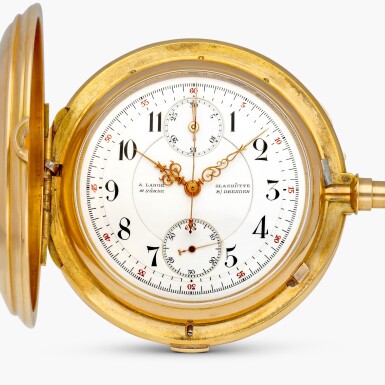
A. Lange & Söhne, Glashütte
A fine pink gold hunting cased keyless lever chronograph watch with register, No. 32813 | Circa 1894
Auction Closed
May 10, 02:36 PM GMT
Estimate
10,000 - 20,000 CHF
Lot Details
Description
Dial: white enamel, Arabic numerals with minute ring above and red Arabic 5-minute markers, outer chronograph track calibrated for fifths, sunken centre and two sunken subsidiary dials for constant seconds and 30-minute register, gold Louis XV style hands, signed A. Lange & Söhne, Glashütte B/Dresden
Calibre: 1a quality, 19''' cal. 43 gilded ¾ plate, gold lever and escape wheel, bi-metallic compensation balance, decoratively engraved balance cock, precision swan-neck regulation, diamond endstone, some jewels carried in screwed gold chatons, chronograph mechanism partially visible to the backplate, signed and numbered A. Lange & Söhne, Glashütte, 32813
Movement number: 32'813
Case: "Louis XV" 18k pink gold, polished covers, case opened via pusher through crown, the chronograph activated via the crown's pusher whilst the cover is open, slide for hand-set beneath the bezel at 4 o'clock, plain polished gold cuvette, covers and cuvette signed A. Lange & Söhne, Glashütte, back cover and cuvette numbered 32813, front cover numbered 13
Case number: 32'813
Size: 54mm diameter
Box: no
Papers: no
Accessories: none
Sotheby's, Geneva, Masterworks of Time: Adolf Lange, The Golden Era of Glasshütte, Novemeber 2019, Lot 112
Martin Huber, Die Uhren von A. Lange & Söhne Glashütte Sachsen, 1988, p.173
Martin Huber, Die Lange Liste, 2000, pp. 140-145 table 42
Reinhard Meis, A. Lange & Söhne The Watchmakers of Dresden vol II, 2012, p. 238, figs. 763-764
Hunting cased chronographs, such as the present example by A. Lange & Söhne, display subtle yet important differences when compared to their open-faced counterparts. While the chronograph mechanism itself is essentially mirrored, the movement layout is adapted, with the barrel positioned to the right of the winding stem.
Additionally, the minute register components are positioned on the dial side and concealed beneath it, offering greater protection to these delicate parts.
In earlier examples, as seen here, the crown performed a dual function, both opening the protective cover and activating the chronograph. In later hunting cased chronographs, this system evolved, with the chronograph operated instead by a separate pusher set into the case band.