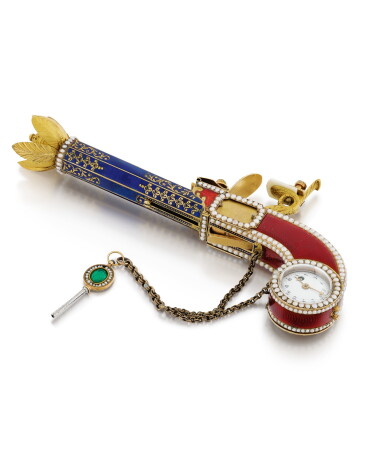
A PEARL, GOLD AND ENAMEL SCENT SPRINKLER AUTOMATON PISTOL, ATTRIBUTED TO MOULINIÉ, BAUTTE & CO., GENEVA, CIRCA 1805
This lot has been withdrawn
Lot Details
Description
A PEARL, GOLD AND ENAMEL SCENT SPRINKLER AUTOMATON PISTOL, ATTRIBUTED TO MOULINIÉ, BAUTTE & CO., GENEVA, CIRCA 1805
in the form of a flintlock pistol, the butt enamelled in translucent scarlet enamel over scale engine-turning, one side with a pearl-framed aperture containing a watch movement with verge escapement, a cut-cornered rectangular plate chased with a hound at the hunt between the barrel and the butt, its counterpart a chased deer, now missing, the faceted barrel enamelled in blue with gold paillon scroll ornaments, revealing a cone-shaped vinaigrette within eight rose petals when the gold trigger and rectangular garnet-set quartz hammer with replacement ivorine washer, crowned by a gold mask, are struck, all framed by split pearl borders, on a gold chain with a pearl-set green enamel key
11cm., 4⅜in. long closed; 12.5cm., 5 in. wide when opened
The Sir David Salomons Collection, cat. no. 88
Vera Bryce Salomons
L.A. Mayer Memorial Institute, Jerusalem, inventory no. WA 2-70
L.A. Mayer Memorial Institute, Jerusalem
George Daniels & Ohannes Markarian, Watches and Clocks in the Sir David Salomons Collection, 1980, no. 88, p. 154;
Ian White, The Majesty of the Chinese-Market Watch, London, 2019, p. 281
The pleasant tradition of sprinkling rosewater, made from highly-scented rose petals steeped in cool water, to refresh and welcome guests after a hot and dusty journey is said to have originated in Iran but was prevalent throughout the Islamic world. The notion of appearing to shoot the visitor with a jewelled and enamelled gold pistol which instead sprayed a tiny amount of rosewater would have been a charming, but expensive, novelty. That such pistols were not only made for the Ottoman and Indian markets but also for the Far East is evident from the example cited below, in the Sandoz collection, which was brought back to Europe from China by the eminent collector, Gustave Loup.
Of the surviving examples of scent spray pistols (around fifteen only are recorded, decorated in the same enamel colours but with a variety of chased animals on the side panels), five are signed by Moulinié, Bautte & Cie. and one, in the Sandoz collection, is signed by the marchand-bijoutier Jean-Baptiste Garrand, (Ian White, The Majesty of the Chinese Watch, AHS, 2019, ch. 6, no. 20). Unsigned pistols like the present example are to be found in the Wilsdorf Collection, Geneva; the Musée International d’Horlogerie, La Chaux de Fonds; the Topkapi Museum, Istambul (the dial with Turkish numerals) and in private collections.
Of all the pieces taken in the distressing burglary of 1983, the pistol has perhaps suffered the most visible external losses since the watch cap is now missing as well as the chased stag panel that once balanced the elegant chased hound. It is well known that the thief took pleasure in deconstructing and reconstructing the watches (see fig. 1), indeed many being recovered still in pieces wrapped in scraps of tissue in small plastic bags so maybe these losses can be regarded not as damage but as historical scars of honour, reminders of the happy recovery of the majority of the stolen objects.