
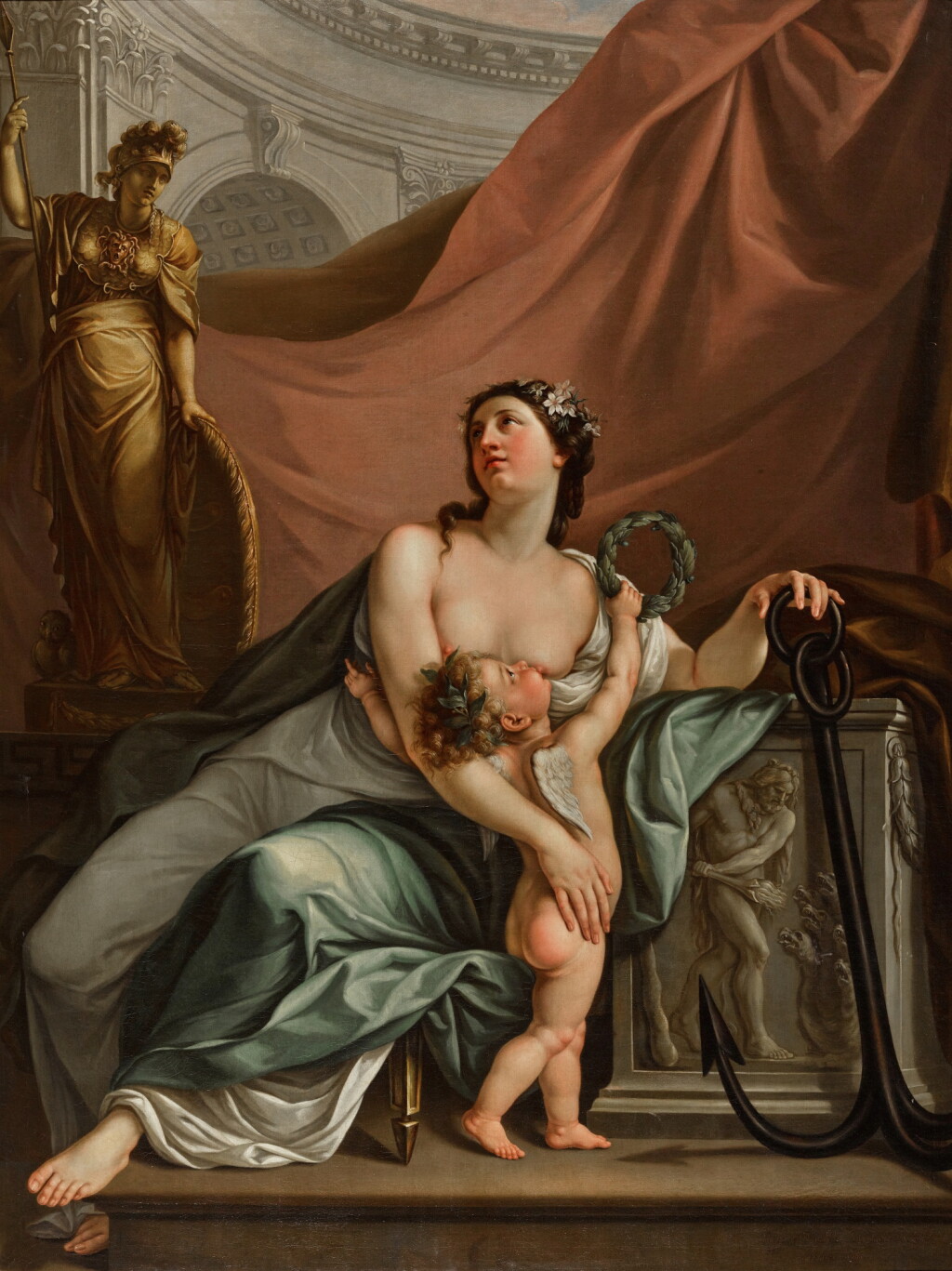
Property from an Important Swiss Private Collection
John Francis Rigaud
Hope nursing the Love of Glory under the gaze of Wisdom
Lot Closed
December 7, 10:55 AM GMT
Estimate
40,000 - 60,000 GBP
Lot Details
Description
Property from an Important Swiss Private Collection
John Francis Rigaud
Turin 1742–1810 Warwickshire
Hope nursing the Love of Glory under the gaze of Wisdom
signed and dated lower right: Rigaud Du Thil Taurinenssis fecit / Romae 1769
oil on canvas
unframed: 192.6 x 144.4 cm.; 75⅞ x 56⅞ in.
framed: 220.5 x 172.3 cm.; 86⅞ x 67⅞ in.
Commissioned by Jean-François-Augustin Mathey, engineer to the Duke of Parma, 1769;
Anonymous sale, Monaco, Sotheby's, 2 December 1989, lot 351;
Where acquired in 1997.
Paris, Grand Palais, Tableaux anciens, Emmanuel Moatti. XVIe Biennale des Antiquaires, 18 September – 4 October 1992, no. 14.
W.L. Pressly, 'Facts and Recollections of the XVIIIth Century in a Memoir of John Francis Rigaud Esq., R.A. by Stephen Francis Duthil Rigaud', in The Walpole Society, vol. 50, 1984, pp. 47–48;
D. Rosenfeld (ed.), European Painting and Sculpture, ca. 1770–1937, in the Museum of Art, Rhode Island School of Design, Providence 1991, p. 112 n. 9;
E. Bénézit, Dictionnaire des peintres, sculpteurs, dessinateurs et graveurs, Paris 1999, vol. XI, p. 702.
Painted in Rome in 1769, this allegorical scene is described at length in John Francis Rigaud's memoirs from that year (see Literature). Hope is personified by the female figure resting her hand on an anchor, while she presses the Love of Glory, in the form of Cupid, to her chest. She turns towards a statue of Minerva, representing Wisdom. Rigaud noted that he avoided filling the composition with superfluous details, wishing instead that 'if there should be any beauty in [my picture], I have endeavored that it should consist in the composition and execution of the figures of which it is composed...'.
Rigaud was born into a French Protestant family, studied in Turin, Florence and Bologna, and lived in Rome for two years from 1768. He came to England in 1771 and became an Associate of the Royal Academy before being appointed a full Academician in 1784. John Boydell commissioned several Shakespearean subject paintings from him for his Shakespeare Gallery, though Rigaud became one of the foremost painters of large-scale decorative schemes for fashionable, late 18th-century interiors. His most important patron was Heneage Finch, 4th Earl of Aylesford, who commissioned Rigaud to decorate the Pompeian Gallery at Packington Hall, Warwickshire, in 1787, and the New Church in 1787 and 1792.