
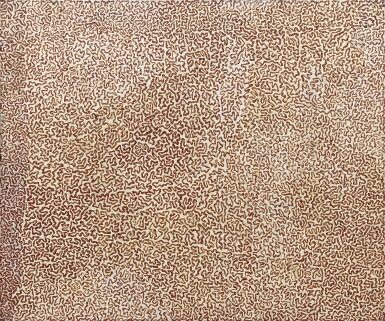
Joseph Jurra Tjapaltjarri
Yunala
Auction Closed
May 23, 09:01 PM GMT
Estimate
40,000 - 60,000 USD
Lot Details
Description
Joseph Jurra Tjapaltjarri
circa 1952-2022
Yunala, 2006
Bears artist's name and Pupanya Tula Artists catalogue number JJ0607104 on the reverse
Synthetic polymer paint on canvas
60 ¼ in x 72 in (153 cm x 183 cm)
Painted for Papunya Tula Artists, Alice Springs, 2006 (Papunya Tula Artists catalogue number JJ0607104)
This painting is accompanied by its Pupanya Tula Artists certificate of Authenticity.
Joseph Jurra Tjapaltjarri was born in the desert interior of Western Australia in 1952. At the time his family lived in the country west of where the Kiwirrkurra community now stands, with only intermittent contact with the increasing number of kartiya (non-Indigenous people) who were beginning to circulate in the region.
Over a decade later, Jurra and his extended family group encountered a Northern Territory Welfare Branch patrol and were brought into the Government settlement of Papunya, 250 miles east. Here, in the company of relatives they’d not seen for many years, they were required to adapt to the sedentary lifestyle of community life.
In 1971, Jurra witnessed several of the settlement's Aboriginal men painting their ancestral stories onto scraps of composition board to be sold in the nearby township of Alice Springs.
This was the beginning of the Western Desert Art movement, a moment in time now etched into Australian art history. However, it wasn’t until the early 1980’s that Jurra was called upon to assist one of his classificatory fathers, Charlie Tjaruru Tjungurrayi with his paintings. A few years later when Jurra began painting as a solo artist he created formal geometric compositions of dotted lines, concentric circles and squares. Within two years he presented his first solo exhibition at the revered Gallery Gabrielle Pizzi in Melbourne, the same year he exhibited in a group show at the John Weber Gallery, New York.
Over time he began to use heavily dotted sinuous lines to illustrate various desert flora. Yunala, 2006, represents the root system of yunala (Bush banana or silky pear vine, Marsdenia australis). Yunala is also the name of a rockhole site where a group of ancestral women gathered to collect this yunala prior to continuing their journey north-east to Wilkinkarra (Lake MacKay). Jurra lived at the remote settlement of Kiwirrkurra in Western Australia where he was recognized as an affable gentleman, equal parts boyish joker and solemn recluse.
Luke Scholes
Image Credits
Joseph Jurra Tjapaltjarri by Stephen Oxenbury
You May Also Like


![[Robert Burns] A Scottish polished burr sycamore snuffbox, probably Mauchline, Ayrshire, 19th century](https://sothebys-md.brightspotcdn.com/dims4/default/8c2252a/2147483647/strip/true/crop/6732x6732+0+0/resize/150x150!/quality/90/?url=http%3A%2F%2Fsothebys-brightspot.s3.amazonaws.com%2Fmedia-desk%2F6d%2Feb%2Fabce5d0d4a0a9ec8ff490de5cf58%2Fl26402-dldpq-t3-04.jpg)


