
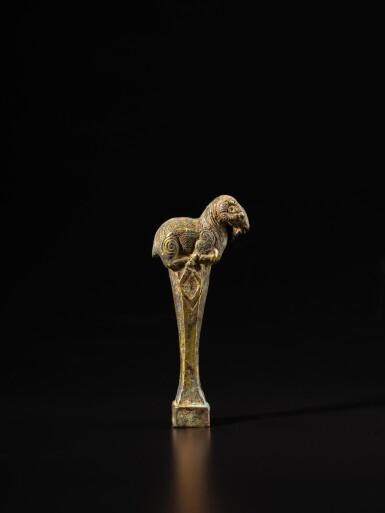
A gilt-copper 'ram' zither tuning key, Eastern Zhou dynasty, Warring States period | 東周 戰國 銅鎏金臥羊琴軫鑰
Auction Closed
March 22, 08:01 PM GMT
Estimate
8,000 - 12,000 USD
Lot Details
Description
A gilt-copper 'ram' zither tuning key
Eastern Zhou dynasty, Warring States period
東周 戰國 銅鎏金臥羊琴軫鑰
Height 3½ in., 9 cm
Collection of Harry Geoffrey Beasley (1881-1939).
Collection of Alfred William Cowperthwaite (1890-1964), acquired circa 1939, and thence by descent.
Harry Geoffrey Beasley (1881-1939) 收藏
Alfred William Cowperthwaite (1890-1964) 收藏,得於約1939年,此後家族傳承
Originally thought to be ornamental fittings, the precise function of the present key remained a mystery until the excavation of a Han dynasty tomb in 1983, where a similar example was discovered together with matching turning pegs (see Jenny So, 'Different Turns, Different Strings: Court and Chamber Music in Ancient China', Orientations, May 2000, p. 31). According to So, because the pegs were small and packed close together on a zither, a tuning key was needed to access them for tuning.
Traditionally, these tuning keys are usually surmounted by animals and mythical beasts. See a closely related example, also surmounted by a ram, excavated in Changzhi, Shanxi province, now in the Shanxi Museum, Taiyuan, illustrated in ibid., fig. 16; another with a feline and snake in combat is in the National Museum of Asian Art, Washington, D.C. (accession no. F1916.454); a third, surmounted by a bear, previously in the collection of Mr. and Mrs. Eugene Victor Thaw, is now in the Metropolitan Museum of Art, New York (accession no. 2002.201.150). A line drawing of a closely related example is illustrated in Bo Lawergren, 'The Iconography and Decoration of the Ancient Chinese Qin-Zither (500 BCE to 500 CE)', Music in Art: International Journal for Music Iconography, vol. XXXII, Spring-Fall 2007, pl. 9. See a Warring States period tuning key surmounted by a mythical beast, sold at Christie's New York, 22nd March 2012, lot 1529; and one with two monkeys, sold in the same rooms, 15th September 2010, lot 910.
You May Also Like


