Property of a Lady
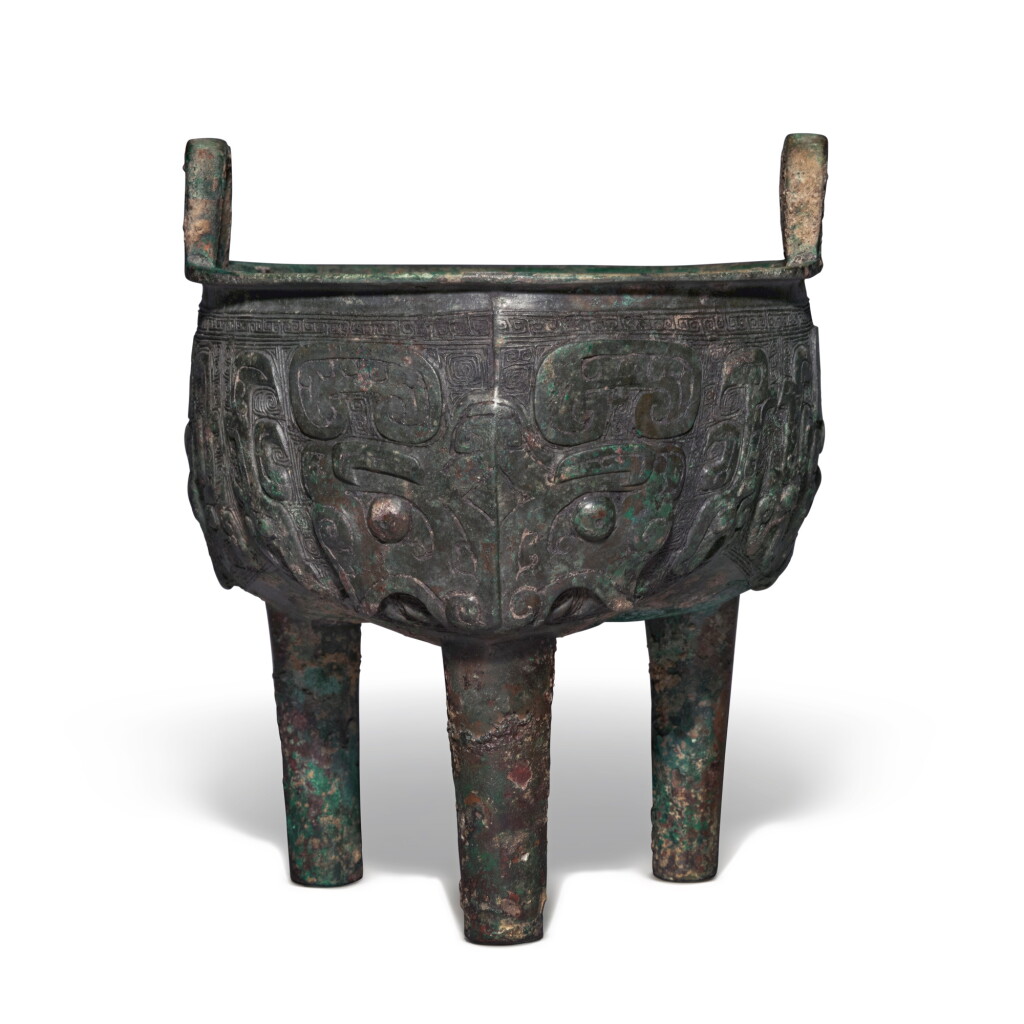
The Shen Mu Ji Ding, Late Shang dynasty | 商末 矢又母己鼎
Auction Closed
March 22, 08:01 PM GMT
Estimate
80,000 - 120,000 USD
Lot Details
Description
The Shen Mu Ji Ding
Late Shang dynasty
商末 矢又母己鼎
cast to the interior wall with a three-character inscription reading Shen Mu Ji
銘文:
矢又母己
Height 7⅛ in., 18.2 cm
Collection of Dr. A.F. Philips (1874-1951).
Sotheby's London, 30th March 1978, lot 17.
The Michael Michaels Collection.
Christie's London, 6th November 2017, lot 179.
安東•飛利浦博士 (1874-1951) 收藏
倫敦蘇富比1978年3月30日,編號17
邁爾克•麥克收藏
倫敦佳士得2017年11月6日,編號179
The three-character inscription indicates that the owner of this ritual bronze, who belonged to the Shen clan, made this vessel for Mother Ji. While there is a group of extant bronzes bearing the same pictogram, little is known about this clan. The clan sign Shen 矢又, which is represented by an abstract symbol of a hand shooting an arrow, perhaps suggests its military association. According to a list of published bronzes from this clan complied by He Jingcheng in Shangzhou qingtongqi zushi mingwen yanjiu [Study of the clan pictograms on the bronzes from the Shang and Zhou dynasties], Jinan, 2009, p. 364, the Shen clan existed already in the late Shang dynasty and remained active until at least the mid-Western Zhou period, evidenced by a related bronze zhi (made by a member of the clan for Father Ji), formerly in the collection of Liu Tizhi, now in the National Museum of China, Beijing, published in The Institute of Archaeology, Chinese Academy of Social Sciences, ed., Yinzhou jinwen jicheng [Compendium of Bronze Inscriptions from Yin and Zhou Dynasties], Beijing, 2007, no. 06284.
For bronze ding of the same form and design, see two closely related examples, excavated at Guojiazhuang and Xiaomintun respectively, near Anyang in Henan province, now in the collection of the Archaeological Research Institute of the Chinese Academy of Social Sciences, Beijing, illustrated in Zhongguo qingtongqi quanji, vol. 2, Beijing 1997, pls 58 and 59. Two further examples, one discovered in Huangcai town, Ningxiang city, Hunan province and the other in Lulong county, Hebei province, are illustrated in Robert W. Bagley, Shang Ritual Bronzes in the Arthur M. Sackler Collections, Washington DC, 1987, p. 488, figs 3.3 and 93.4, respectively.
Compare also several auctioned examples of this type, three sold in these rooms: one of a similar size, from the collection of J.T. Tai, 22nd March 2011, lot 8; the second of a slightly smaller size, formerly in the collection of Mr. and Mrs. James K. Cull, and later entering the collection of Max Loehr, 17th-18th March 2015, lot 153; the third of a slightly larger size from the collection of Alex and Elizabeth Lewyt, acquired from professor Alfred Salmony in the 1950s, 17th-18th September 2013, lot 18; and another, formerly in the collection of Louis Austin, sold in our London rooms, 10th November 2010, lot 209.
Dr. Anton F. Philips (1874-1951) was co-founder of the Philips Group of companies that started in Eindhoven in The Netherlands as a light bulb factory and also a first cousin of Karl Marx. An observatory in his hometown, which he donated, is still named after him, the Dr. A.F. Philips Sterrenwacht. The important collection of archaic Chinese bronzes and other works of art that he had assembled was sold in our London rooms in 1978.
You May Also Like