
Property from a Private Collection, New York
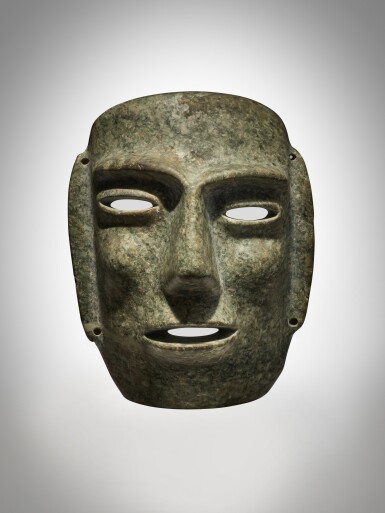
Chontal Stone Mask, Late Preclassic, circa 300 - 100 BC
Lot Closed
November 21, 07:31 PM GMT
Estimate
10,000 - 15,000 USD
Lot Details
Description
Property from a Private Collection, New York
Chontal Stone Mask
Late Preclassic, circa 300 - 100 BC
Height: 6 ¾ in (17.2 cm)
American Trade, acquired from the above
Sotheby's, New York, May 16, 2008, lot 12, consigned by the above
Private Collection, New York, acquired at the above auction
Though perhaps less well-known than the sharply geometric style of its neighboring culture, the Mezcala, Chontal art merits attention and distinction from the former. Chontal stone sculpture is largely figurative. Modeled face-panels and masks notably boast abstracted representations of human faces that are occasionally - and strikingly - softened by a perceived naturalism found within deep, rounded grooves, adding depth and occasional suppleness to bones and brows. This particular mask straddles this threshold between stone stiffness and gentle, worldly likeness. Sprouting from the figure’s prominent nose, his brow arches and casts a shadow over his open-work oval eyes. The figure’s mouth is similarly stylized, carved simply and deeply. The cheeks, which subtly rise from the hard, mottled green and white porphyry suggest a surprising fleshiness - imbuing the elongated face with touches of familiar physicality.
As figurative objects, masks are believed to have held an important role in Chontal culture and spirituality, especially in relation to funerary rites. As Carlo Gay writes, "[Chontal masks] suggest a relationship between death and ritual, in which death is a transition from one state to another, a return to the world of the ancestors through a passage or voyage requiring appropriate symbolism to represent its liminal condition" (Carlo Gay and Robin Gay, Chontal: Ancient Stone Sculpture from Guerrero, Mexico, Geneva, 2001, p. 71).
You May Also Like


