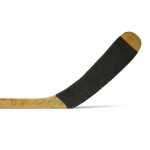

Wayne Gretzky 1985 Stanley Cup Finals Championship Clinching Game-Used & Signed Stick | Photomatched to Postgame Handshake Line | May 30, 1985 | Second Straight Stanley Cup Victory | Record For Most Points in a Postseason | Record for Most Combined Regular Season and Playoff Points
Auction Closed
September 30, 11:40 PM GMT
Estimate
Upon Request
Lot Details
Description
TITAN, TITAN TPM 2020 Hockey Stick
Wood, Tape
1984-1985 SEASON
There are only a few athletes who are near-universally accepted as the greatest in their sport: Wayne Gretzky is one of the few in that rarefied air. Known to many sports fans simply as “The Great One,” Gretzky’s impact on the sport of ice hockey in North America and around the world simply cannot be overstated.
Sotheby’s is proud to present an artifact that was with this legend of the sporting world at the culminating point of one of the most dominant seasons ever played by an athlete in a team sport: Wayne Gretzky’s 1985 Stanley Cup Finals Clinching Game-Used Stick, the second championship of his legendary career and the culmination of the highest scoring postseason for a player in NHL history, signed by the legend himself.
The 1984-85 season saw Gretzky at the height of his powers. He had just led the Edmonton Oilers to his and their first Stanley Cup in the 1984 Stanley Cup Finals after completing the second 200 point season of his career with 205, a feat no other NHL player has ever achieved even once, and winning his fifth Hart Trophy in a row. Now, Gretzky and the Oilers had their sights set on a rare feat in sports: repeating.
Somehow, Gretzky only got better. Gretzky notched his fourth straight season with 70 or more goals, scoring 73, and paired it with an incredible 135 assists for a total of 208 points: the third 200 point season of his career and the third highest scoring season of his career. Gretzky also led the league in plus-minus for the fourth straight season, posting a staggering 100 in the category, and led his team to first in their division. The Edmonton Oilers steamrolled through the postseason to their third Stanley Cup Final appearance in as many seasons, this time matched up against the Philadelphia Flyers.
Gretzky meanwhile was a man possessed, scoring a blistering 36 points through the first three rounds despite only playing 13 games, leaving him just two short of his own record for most points in a single postseason set just two seasons prior. In game 4 of the second round, he tied his then-record of seven points in a single postseason game.
The Flyers managed just one win in the Final, a 4-1 victory in front of the Philadelphia crowd in Game 1. From then on, Gretzky and the Oilers never relented. The final game of the series, in front of the Edmonton faithful, left nothing to chance. By the end of the first period, the Oilers were up 4-1 and Gretzky already had two assists. He added another assist and scored the Oilers seventh goal in the second, putting Edmonton up 7-1. The third period was a formality, with Philadelphia scoring twice while Gretzky’s teammate scored an eighth goal for the home team and with that, the Oilers and Gretzky had their second title.
Gretzky’s final point total for the postseason stood at 47, a record that stands to this day, and Gretzky won his first of two Conn Smythe trophies for MVP of the playoffs. Gretzky's 255 combined regular season and playoff points also still stands. Two weeks later, he picked up his sixth consecutive Hart Trophy. No other player in NHL history has won more than six total.
This stick was with him as his dreams of becoming a repeat champion became a reality, after his historic labor had borne the ultimate fruit. This stick saw Gretzky put even more space between himself and the rest of hockey history. Gretzky’s run from 1980-1987 is often viewed as one of the most dominant in any team sport, and his 1984-85 season played a major role.
The stick is accompanied by a letter from MeiGray matching the stick to the handshake line following the series clinching fifth game and JSA in regards to the signature.
Gretzky Wins his Second Cup and Smashes the Record Books
When Gretzky skated off the ice on May 30, 1985 with his second straight Stanley Cup Finals win in hand, he did so in historic fashion. He had set the record for most points in a single NHL postseason by a player on one of the greatest teams of all-time: 47.
No other player had ever scored more than 40. Gretzky had taken the record from himself, which he had set in the 1983 postseason with 38, and his closest competition in the rankings was his own teammate, Paul Coffey, who notched 37 alongside him in 1985.
Perhaps even more impressive is how few games Gretzky needed to set such an impressive record. The Oilers only played 18 games in the 1985 postseason, sweeping the first two rounds before besting Chicago in six in the Conference Finals and dispatching the Flyers in just five games. Besides Coffey, no one else in the top 10 single-postseason scorers has achieved that distinction in less than 20 games. Although Mark Messier and Connor McDavid have since joined Gretzky as players who have scored 40 or more, neither did it in less than 23 games.
Fans who saw Gretzky witnessed a player the likes of which we may never see again, however those who watched the 1985 Stanley Cup Playoffs saw The Great One soar to even greater heights.
Gretzky set over 61 individual NHL records, and won 9 Hart Memorial Trophies and 4 Stanley Cup championships. The NHL’s all-time point leader, Wayne Gretzky is the only player in NHL history to have his number retired league-wide.
Born and raised in Brantford, Ontario, Gretzky, an undersized player, brought speed and finesse to a highly physical game. Often compared to a geographer or a chess player for his ability to think multiple plays ahead of opponents, Gretzky’s knack for being ‘in the right place at the right time’ made him a defensive nightmare.