
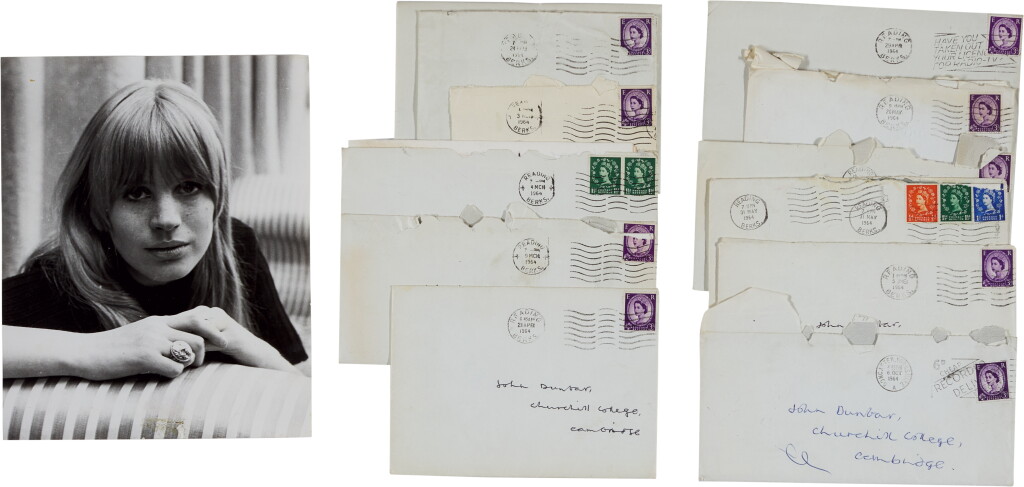
John Dunbar / Marianne Faithfull
A Personal Collection Of Autograph Love Letters And Correspondence Relating To The Rolling Stones And 'As Tears Go By', From Marianne Faithfull To John Dunbar, circa 1964
No reserve
Lot Closed
September 12, 01:02 PM GMT
Estimate
5,000 - 7,000 GBP
Lot Details
Description
A deeply personal collection of handwritten correspondence and love letters from Marianne Faithfull to John Dunbar, whom she married in 1965. The collection comprising:
11 handwritten letters in envelopes, each addressed to 'John Dunbar, Churchill College, Cambridge', the envelopes with date stamps from 24th February to 6th October, 1964:
(1p. double-sided) 24th February 1964.
(1p. double-sided) 21st April 1964.
(2pp. double-sided) 29th April 1964, concerning the Rolling Stones' reaction to her recording of 'As Tears Go By' ("The Rollin' Stones were so pleased they all gave me a kiss and Andrew Oldham say [sic] 'It's better than sex', whatever that means...").
(5pp.) 3rd March 1964, on tracing paper with doodled caricature.
(2pp.) 4th March 1964.
(3pp.) 9th March 1964.
(1p. double-sided) 26th May 1964, concerning early celebrity status ("...it was so odd to think that I... have become almost a name to drop!").
(1p. double-sided) 28th May 1964, concerning career aspirations ("...my record will reach NO.1! (Like hell!)").
(2pp.) 31st May 1964, concerning auditions for drama schools including RADA.
(2pp.) 5th 'JNEI' 1964, concerning early press exposure ("Tomorrow I have an interview with a reporter from the 'Sunday Mirror' with photographs...").
(3pp.) 6th October 1964, concerning her first tour experience ("We argue about pop music, the whys & wherefore of the group scene, and of course the characteristic show-biz bitching sessions").
5 additional handwritten letters (not in envelopes), from Marianne Faithfull to John Dunbar, circa 1964, including:
(1p. double-sided).
(1p. double-sided) concerning the imminent release of a demo record ("...the week of the play I'm doing at the moment and the week the record comes out!")
(5pp.) concerning the recording of a B-side ("The recording business seems to be sorting itself out, and on Friday I record the other side (wait for it... it's going to [be] Greensleeves!")
(2pp. double-sided) concerning 'As Tears Go By' ("I also learned the other side which is by the Rolling Stones, and in my opinion is much better...")
(3pp.) concerning the US release of 'As Tears Go By' ("I went up on Friday to record the 'B' side of 'As Tears Go By'. Well, 'Greensleeves' was so good that they've decided it's going to be an 'A' side. So It's going to be released in America at about the same time as 'Tears Go By' - Fantastic Luck!").
And six additional empty envelopes, each addressed to 'John Dunbar, Churchill College, Cambridge', dated April-June 1964, three of which have annotations or doodles;
An undated handwritten letter (2pp. ) in blank envelope, the undated letter addressed to 'My Dearest John' concerning an early demo recording session, signed 'from Marianne xxxx' with doodled caricature, circa 1964;
A undated Rijksmuseum postcard handwritten by Marianne Faithfull to John Dunbar with doodled caricature, circa 1964;
And a vintage black & white, photographic print of Marianne Faithfull, mid-1960s.
Dimensions
Envelopes various sizes, the larger 7 1/4in x 3 1/2in (18.5cm x 9cm)
The photo 7 1/4in x 8 3/4in (18.5cm x 22.2cm)
Provenance
Offered directly by photographer and artist John Dunbar, who married Marianne Faithfull in 1965.
1964 marked the start of a transformational period in the life and career of Marianne Faithfull . Only 17 years old, her recording of the Jagger/Richards-penned track 'As Tears Go By' broke into the top 10 on the UK charts on its release in June. Her aspirations and frustrations for her recording career and rising stardom are recorded in vivid detail in a series of letters to John Dunbar: her boyfriend at the time, they were married and she gave birth to their son the year after. These love letters and correspondence provide a unique insight into Faithfull's mind in the months immediately before and after her extraordinary musical breakthrough and accelerating career. John Dunbar was an active member of the counterculture movement and in 1965 founded the Indica Gallery, exhibiting numerous artists from the Fluxus movement including Yoko Ono.
Marianne recalls meeting Andrew Loog Oldham first the first time at a party in 1964:
'"Who is she? Can she act? What's 'er name?" - handing John, in the same breath, an oversized, flashily printed card. "Andrew Loog Oldham, darling"... Andrew asked almost as an afterthought: "Can she sing?"/John: I think she can, why the hell not? You can sing, can't you Marianne?"/And that was that.'
Literature
M. Faithful and D. Dalton, 1994, Faithful: An Autobiography, Little, Brown & Company (Canada) Limited, pp.21.