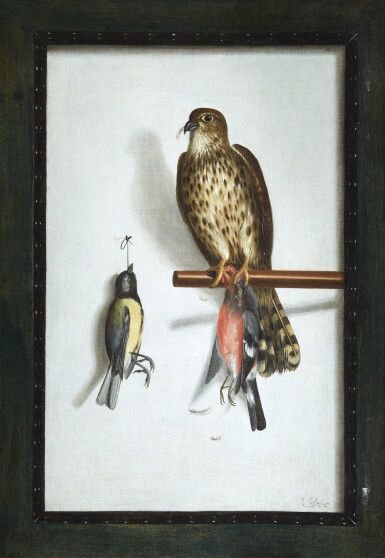
CORNELIS BILTIUS | TROMPE L’ŒIL WITH A FALCON AND ITS PREY
Lot Closed
May 10, 03:07 PM GMT
Estimate
10,000 - 15,000 GBP
Lot Details
Description
Property from the SØR Rusche Collection
CORNELIS BILTIUS
The Hague 1653 - after 1685
TROMPE L’ŒIL WITH A FALCON AND ITS PREY
indistinctly signed lower right: C.bilcius
oil on canvas
unframed: 62.9 x 44.5 cm.; 24¾ x 17½ in.
framed: 70.6 x 52.5 cm.; 27¾ x 20¾ in.
Please see shipping calculator link: click here.
Anonymous sale, Amsterdam, Paul Brandt, 7 April 1975, lot 67, when acquired.
Rotterdam, Kunsthal, At Home in the Golden Age, 9 February – 18 May 2008, no. 5.
The SØR Rusche Collection has been exhibited extensively over the last two decades. Please click here for further information.
K. Nicolaus, DuMont's Bild-Lexikon zur Gemäldebestimmung, Cologne 1982, pp. 197–98 and 203, reproduced pp. 199 and 204, figs 160c–d, and 164k–l;
K. Nicolaus, 'Signaturen - echt oder gefälscht', in Kunst & Antiquitäten, no. 3, Munich 1988, reproduced figs 9–11;
E. Gemar-Költzsch et al., Holländische Stillebenmaler im 17. Jahrhundert, Lingen 1995, vol. II, p. 111, cat. no. 29/2, reproduced in colour vol. I, p. 121, plate 13;
H.-J. Raupp (ed.), Niederländische Malerei des. 17. Jahrhunderts der SØR Rusche-Sammlung, vol. 5, Stilleben und Tierstücke, Münster/Hamburg/London 2004, pp. 62–65, cat. no. 7, reproduced in colour;
W. Pijbes, M. Aarts, M. J. Bok et al., At Home in the Golden Age, exh. cat., Zwolle 2008, p. 36, cat. no. 5, reproduced in colour.
Cornelis Biltius specialised in trompe l’œil depictions of game, hunting equipment and letter racks. Cornelis was originally from The Hague but worked in various locations in Germany from the 1670s and between 1680 and 1686 was in the service of the Oberhofmeister of the Electorate of Trier Von Bronsar.
This work was formerly overpainted so that the form of the bird in the falcon’s claws was disguised. It has now been returned to its original appearance, as has the signature, which had been adapted to suggest that the painting was the work of Cornelis' father, Jacob Biltius (1633–81).